
Paper annotation
Nature · 2021
The Annotated AlphaFold2
An explanation of Jumper et al. (2021), with code from a compact PyTorch implementation. Covers the Evoformer, Structure Module, and training losses.
Continue reading:- Reading time
- 90 min
- Chapters
- 16
- Code excerpts
- 37
- Interactive figures
- 8
Source and annotation details
Original paper. John Jumper, Richard Evans, Alexander Pritzel, et al. (2021), Nature.DOI 10.1038/s41586-021-03819-2.
Annotation published April 21, 2026.
Code excerpts link to reference commit f2e6c23.
0. Prelims
Throughout this guide, we’ll use minAlphaFold2, a compact reimplementation of AlphaFold2 in PyTorch. The repository is available at https://github.com/ChrisHayduk/minAlphaFold2.
The DeepMind implementation is a full research codebase with the supporting features required for training and inference. minAlphaFold2 has a narrower purpose: it keeps the central operations in a smaller codebase and makes their correspondence with the paper explicit.
Variable names follow the paper. m is the MSA representation, with shape , where is the number of sequences, is the number of residues, and is the channel dimension. z is the pair representation, with shape . s_i is the single representation in the Structure Module. T_i is a rigid frame. This makes it easier to compare the implementation with the paper and supplement.
Algorithms are annotated inline. Every major class and function in minAlphaFold2 cites the supplement algorithm it implements. Comments like # Algorithm 7 appear right above the relevant forward method, allowing you to reference the description and pseudocode from the paper while reading the code. When I say “Algorithm 7” below, you can grep for it in the repo to find the corresponding code. Shapes are typically asserted throughout the forward pass, and the tests exercise those assertions end-to-end.
There are three config profiles living under configs/, intended to provide runnable versions of minAlphaFold2 for a range of compute budgets:
tiny.toml— about 90k parameters, CPU-runnable, good for unit tests and for the overfit walkthrough in §14.medium.toml— for overfit experiments on a single GPU.alphafold2.toml— the full 48-block, paper-spec config.
The walkthrough below will mostly stay at the level of the architecture, but when we get to the concrete example in §14, we’ll load tiny.toml and watch the Structure Module actually converge on a real protein.
1. Background
AlphaFold2 was not the first deep-learning approach to protein structure prediction, but its CASP14 results represented a large improvement over prior computational methods. For many targets, its predictions approached the accuracy of experimentally determined structures. Understanding the architecture first requires some biological context, particularly the relationship between sequence, evolution, and structure.
1.1 What are proteins
Let’s start with a seemingly simple question - what are proteins and why should we care about them?
Proteins are large molecules produced within the cells of living organisms to perform some function. You can think of proteins as the machinery of life. They are responsible for facilitating chemical reactions in the body, providing structural integrity to cells, acting as receptors, and more. Quite simply, life as we know it would not be possible without the vast array of protein-based nanomachines constantly at work in our bodies.
The functions that a protein takes on (e.g., whether it acts as a receptor attached to a cell membrane or as a catalyst for a chemical reaction) come down in large part to its 3D structure. The shape of the protein determines what other molecules it can interact with, thereby determining what it can do in the body.
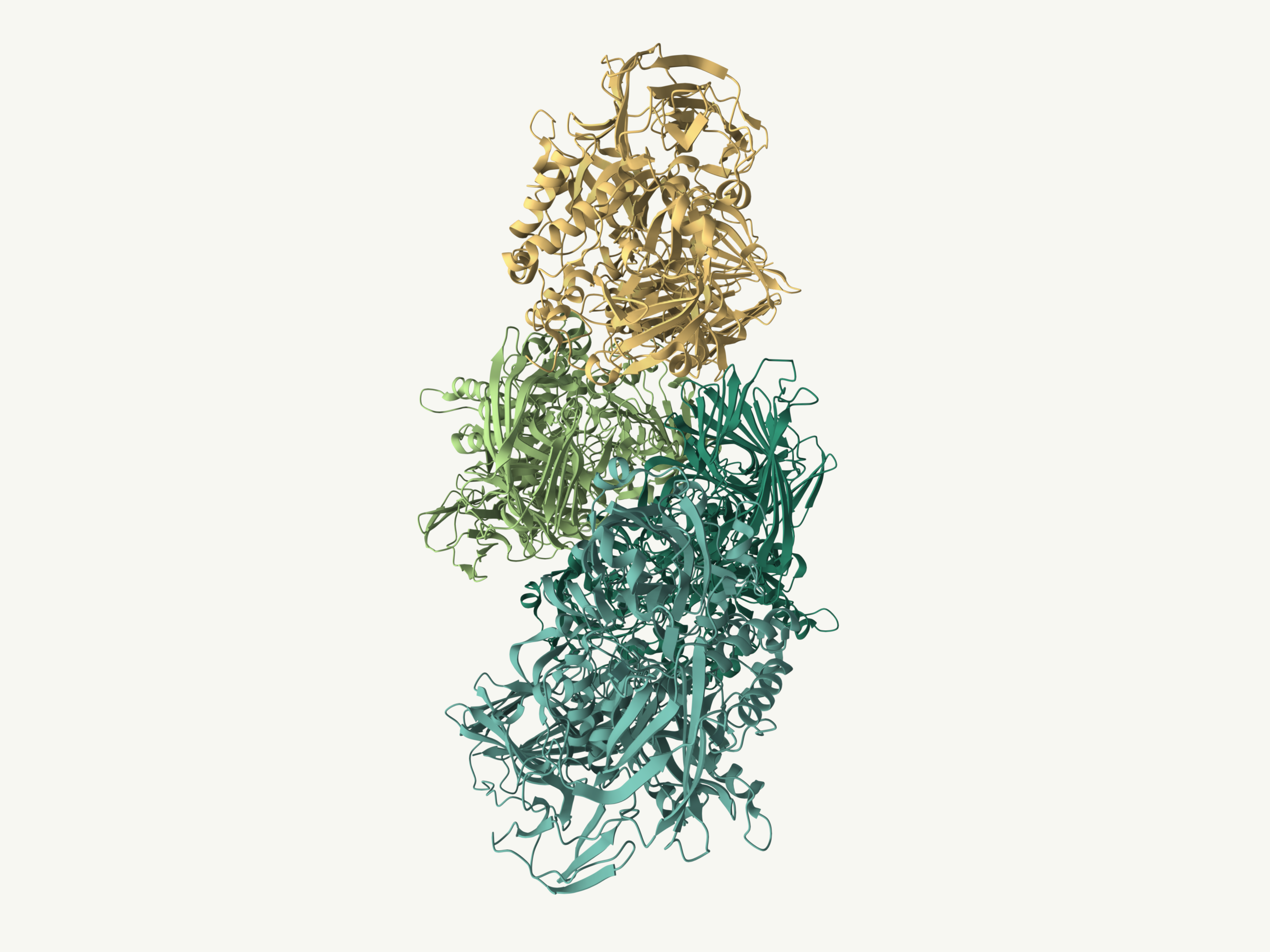 View full resolution ↗
 Yeast lactase
This enzyme breaks lactose into glucose and galactose. Four copies of the protein fit together to form the assembly shown here.
Each ribbon follows a folded protein chain. The colors distinguish the four subunits.
- Chain A
- Chain B
- Chain C
- Chain D
Now, if proteins are so important, it may be natural to ask “where do they come from?” And herein lies the central role of DNA in living organisms.
It is a common cliché to hear that DNA is the system of record for an organism, or the set of instructions for life. But it is less often said exactly what instructions DNA is providing.
DNA encodes instructions for making proteins. It also helps control which proteins a cell produces and when. First, a gene is transcribed into RNA. Ribosomes then read groups of three RNA bases, called codons, to build an amino-acid chain. Most codons specify an amino acid; stop codons signal the end of translation.
DNA → mRNA → an amino-acid chain
A short coding-region example. Read each sequence in the direction shown.
DNA
Coding strand · 5′ → 3′
Template strand · 3′ → 5′
RNA polymerase reads the complementary template strand.
mRNA
Message · 5′ → 3′
The coding sequence matches the DNA coding strand, with U in place of T.
Amino-acid chain
Build from the N- to the C-terminus
Hence, from two different views, a protein is simultaneously a one-dimensional string of amino acids and also a three-dimensional, interactive structure. How can we reconcile these two views?
They’re connected by what’s known as protein folding.
1.2 The protein folding problem
Protein folding is the process by which the one-dimensional amino acid sequence output by the ribosomes folds into its ultimate 3D shape. As we discussed earlier, this shape determines the functions that the protein can fulfill in the body. Thus, function follows structure, and structure follows sequence.
In practice, determining a protein’s amino acid sequence is much easier, faster, and cheaper than determining its 3D structure, so it would be nice to be able to predict the structure from the sequence. Unfortunately, this task was historically nearly impossible.
The protein folding problem is hard for the reason Cyrus Levinthal pointed out in 1969: a sequence of length 100 has something like possible conformations if each residue has three rotational states. The search space is too large for brute-force enumeration, yet proteins fold reliably on biological timescales.
The only way this can happen is if the energy landscape is highly biased. Rather than sample uniformly from all possible conformations, proteins are being funneled by the physics of their interactions toward a small set of low-energy structures.
This insight opens the door to modeling the funneling dynamics present in protein folding. For decades, the field tried to model that funnel directly through molecular dynamics, statistical potentials, fragment libraries, and many other approximations. These methods worked in pieces, but not well enough at the proteome scale due to their immense computational cost. Running a full molecular dynamics simulation for large proteins was just computationally intractable.
AlphaFold2’s core innovation was to stop trying to explicitly simulate the entire physical process and instead learn the shape of the funnel from data. We’ll discuss two of these key data sources in the next two subsections (1.2 and 1.3).
1.3 MSAs and evolutionary coupling
The key insight that unlocks protein folding, which predates AlphaFold2 by decades, is that related proteins across species tend to share the same domains, and the mutations they accumulate over evolutionary time are not independent. If amino acids and in the protein sequence are in contact in the 3D structure, then a mutation at that disrupts that contact creates selection pressure for a compensating mutation at . That is, if doesn’t mutate to compensate for the mutation at , then the protein won’t successfully fold into the shape needed to achieve its function. Over millions of years and many species, that pressure leaves a statistical signature - the columns for residues and in a multiple sequence alignment co-vary.
A multiple sequence alignment, or MSA, is exactly what it sounds like. We take the target sequence, find a large set of evolutionarily related sequences, and align them so that homologous residues are in the same column.
(Terminology note: homologous == “evolutionarily related positions in the amino acid sequences”, residue == “a single amino acid in a sequence”)
We can see an example of a small MSA below. The rows represent related proteins from various species. Each column is an aligned position in those sequences (e.g., amino acid 1 is in the first column).
H. sapiens       - - - - - G D V E K G K K I F I M K C S Q C H
E. caballus      - - - - - G D V E K G K K I F V Q K C A Q C H
G. gallus        - - - - - G D I E K G K K I F V Q K C S Q C H
D. melanogaster  - G V P A G D V E K G K K L F V Q R C A Q C H
S. cerevisiae    T E F K A G S A K K G A T L F K T R C L Q C H
From an MSA, you can infer a surprising amount. Column variation tells you which residues are conserved, meaning evolution has decided they matter, and which residues are free to drift.
(Another terminology note: in biology speak, “conserved residues” just means amino acids in the same position that don’t change across species in the MSA.)
Correlated columns tell you which residues are coupled, which is often the signature of contact in 3D. This is why AlphaFold2 treats the MSA as a first-class input rather than as a side feature - these coupled residues give the model a strong starting point to “guess” which residues should be next to each other in the 3D structure.
Do strongly coupled positions sit next to each other in the folded protein? The example below compares three residue pairs in bovine β-trypsin (PDB 2PTN), using scores from an alignment of about 2,000 serine proteases. Start with the presets: one coupled pair is close in 3D, while another is far apart. A high score is evidence for a contact, not a guarantee. Select cells in the heatmap or columns in the alignment to highlight the same pair in the 3D structure.
AlphaFold2 builds its MSAs by searching four databases with two tools (HHBlits for sensitivity, JackHMMER for coverage):
- MGnify — metagenomic sequences, where a lot of novel protein diversity lives.
- UniRef90 — clustered UniProt, the main protein sequence database.
- Uniclust30 — another clustering of UniProt, at 30% sequence identity.
- BFD — Big Fantastic Database, billions of sequences assembled from raw metagenomic reads.
1.4 Templates
With MSAs, we are looking at sequences that are evolutionarily similar to our target sequence in order to find correlations in individual amino acids. But if we already know the solved 3D structure of one of these similar proteins? If its sequence is very close to our target, shouldn’t its structure be close as well?
This is where templates come in, forming the second source of prior knowledge AlphaFold2 uses. If an evolutionarily related protein already has a solved 3D structure in the Protein Data Bank, its coordinates can be used as a hint for the model to “guess” at the coordinates of the target protein. AlphaFold2 finds up to four templates via HHSearch on PDB70, converts them into pair-like embeddings, and injects them into the same broad pipeline as the MSA (i.e., the Evoformer).
Hence, while we can think of MSA as giving us granular information on which pairs. of residues are in contact, we can think of templates as giving us global information about what the entire folded protein might look like.
In practice within AlphaFold2, templates are mostey useful when evolutionary information is sparse (that is, when the MSA search for a protein does not return many hits), but the model does not depend on them in the way older template-based methods did. The MSA and the learned pair representation do most of the work. As such, we will treat templates as an important input-pipeline detail and cover them briefly in §8, rather than making them the center of the story.
1.5 Rigid frames and SE(3)
AlphaFold2 outputs a 3D structure. Its most important intermediate object is a local frame associated with each residue: a position and a rotation that together specify a small coordinate system attached to the backbone. These frames, one per residue, represent the whole structure.
This matters for two reasons. First, frames let us express geometric invariances. The physics of protein folding does not care about the global position or orientation of the molecule. If you translate and rotate the entire structure, it is still the same protein. That is SE(3) invariance, and any loss or model component that respects it has a much easier problem than one that has to learn it from scratch. Second, frames also let us express local geometry. The position of residue as seen by residue is just , meaning the translation in residue ‘s local coordinate system. That “as seen by” operation is the core of Invariant Point Attention, which we’ll get to in §10.
We mostly won’t need frames in §§1–9; we’ll return to them in the Structure Module. The Evoformer updates the pair representation to give the Structure Module the information it needs to place atoms in space.
1.6 What AlphaFold2 changed
The rough outline of a contact-prediction-plus-folding pipeline had existed for years: run an MSA, extract co-evolution signals, predict a residue-residue contact map, then fold the protein through fragment assembly or distance-based minimization. AlphaFold1 was already doing something in this family. AlphaFold2 introduced the following changes:
- End-to-end training. No separate “predict contacts, then fold” pipeline. The entire system, from MSA input to atom coordinates, is one computation graph with one loss.
- The Evoformer. A transformer-style stack that cross-attends between the MSA representation and the pair representation, letting each update the other over 48 blocks.
- Invariant Point Attention. A geometric attention variant that operates on rigid frames, respects SE(3) invariance by construction, and lets the Structure Module reason about 3D without losing equivariance.
- FAPE loss. A frame-aligned loss that measures error per-residue-frame rather than in a global coordinate system, giving every residue a local view of the structure it’s trying to build.
- Recycling. A mechanism that feeds the model’s own output predictions back as input for another forward pass, enabling iterative refinement at both train and test time.
The overview below follows the path from sequence data to atom coordinates. Read it from top to bottom: inputs become MSA and pair representations, the Evoformer updates both, and the Structure Module builds a structure. Select a stage heading to jump to its explanation. §9 shows recycling separately.
From sequence information to atom coordinates
Follow the main prediction path from top to bottom.
Input embedding, extra-MSA processing, and template processing build two working representations.
The streams exchange information through pair-biased attention and the outer product mean.
Use s and z to update residue frames and predict side-chain geometry.
2. Input representations
AlphaFold2 takes in three kinds of raw data (the target sequence, the MSA, and the templates) and distills them into two working representations that flow through the rest of the network:
- the MSA representation , shape , where is the number of sequences in the alignment and is the number of residues.
- the pair representation , shape , with one embedding for every pair of residues in the target sequence.
You can think of as “what we know about each residue, as seen through evolutionary history” and as “what we know about each pair of residues.” The Evoformer passes information back and forth between these two objects: it uses the pair representation to guide attention within the MSA, and the MSA to refine the pair representation via the outer product mean.
2.1 Building the features
The feature builders that turn raw inputs (an integer-encoded sequence, a stack of aligned MSA sequences, and a set of template structures) into embedding-ready tensors live in build_target_feat . Most of this is one-hot encoding and concatenation, but these tensors define what information the network receives. The main features are:
-
build_target_feattakes the target integer-encoded sequence and produces a per-residue feature vector: a one-hot over the 21 amino-acid types (20 + unknown), plus a per-residue “deletion value” and a few binary flags. Dimension 22. -
build_msa_feattakes the full MSA and produces a tensor: for each sequence and each residue, a one-hot over 23 MSA tokens (the 20 amino acids, plus gap, mask, and unknown), a cluster profile giving the average across sequences in that cluster, plus features recording which residues had gap deletions and how many. This is where evolutionary information enters the model. -
build_extra_msa_featdoes the same thing for the “extra MSA” stack, a larger, cheaper-to-process slice of the alignment that gets its own shallower Evoformer (covered in §8).
2.2 The input embedder
Once we have the feature tensors, the InputEmbedder block projects them into and (Algorithm 3 of the supplement). The block uses three linear projections of the target features plus an outer-sum to produce a per-pair embedding for , and one linear projection of the MSA features to produce . It also adds a tiled copy of the target features across all MSA rows.
class InputEmbedder(torch.nn.Module):
    """Initial MSA + pair embedding (Algorithm 3).

    Produces the starting ``m_si`` and ``z_ij`` for the Evoformer by
    combining:

    * three linear projections of ``target_feat`` (shape
      ``(batch, N_res, TARGET_FEAT_DIM)``) — two broadcast into the
      outer-sum for ``z`` and one added to the query row of ``m``;
    * a relative-positional encoding ``RelPos(residue_index)`` added to
      ``z`` (Algorithm 4);
    * a linear projection of ``msa_feat`` (49 channels — cluster profile
      + deletion features, per Table 1) added to every MSA row in ``m``.

    Output shapes: ``m`` ``(batch, N_cluster, N_res, c_m)``, ``z``
    ``(batch, N_res, N_res, c_z)``.
    """

    def __init__(self, config):
        super().__init__()

        self.linear_target_feat_1 = torch.nn.Linear(in_features=TARGET_FEAT_DIM, out_features=config.c_z)
        self.linear_target_feat_2 = torch.nn.Linear(in_features=TARGET_FEAT_DIM, out_features=config.c_z)
        self.linear_target_feat_3 = torch.nn.Linear(in_features=TARGET_FEAT_DIM, out_features=config.c_m)


        self.linear_msa = torch.nn.Linear(in_features=49, out_features=config.c_m)
        init_linear(self.linear_target_feat_1, init="default")
        init_linear(self.linear_target_feat_2, init="default")
        init_linear(self.linear_target_feat_3, init="default")
        init_linear(self.linear_msa, init="default")

        self.rel_pos = RelPos(config)

    def forward(self, target_feat: torch.Tensor, residue_index: torch.Tensor, msa_feat: torch.Tensor):
        # target_feat shape: (batch, N_res, 22)
        # residue_index shape: (batch, N_res)
        # msa_feat shape: (batch, N_cluster, N_res, 49)
        assert target_feat.ndim == 3 and target_feat.shape[-1] == TARGET_FEAT_DIM, \
            f"target_feat must be (batch, N_res, {TARGET_FEAT_DIM}), got {target_feat.shape}"
        assert residue_index.ndim == 2, \
            f"residue_index must be (batch, N_res), got {residue_index.shape}"
        assert msa_feat.ndim == 4 and msa_feat.shape[-1] == 49, \
            f"msa_feat must be (batch, N_cluster, N_res, 49), got {msa_feat.shape}"

        # Output shape: (batch, N_res, c_z)
        a = self.linear_target_feat_1(target_feat)
        b = self.linear_target_feat_2(target_feat)

        # Output shape: (batch, N_res, N_res, c_z)
        # Row i should use element i from a, and col j should use element j from b
        z = a.unsqueeze(-2) + b.unsqueeze(-3)

        z += self.rel_pos(residue_index)

        # Output shape: (batch, N_cluster, N_res, c_m)
        m = self.linear_target_feat_3(target_feat).unsqueeze(1) + self.linear_msa(msa_feat)

return m, zThe embedder initializes the pair representation from an outer-sum of the target features, not from the MSA. The MSA features arrive later through the outer product mean inside the Evoformer. Right after the embedder, contains target-sequence information; the Evoformer will add information about co-evolution. The embedder also tiles the target features across every row of , including rows corresponding to other MSA sequences. This tells each row, “this is your target,” which gives the row attention and column attention operations a shared coordinate system.
2.3 Relative position encoding
The second piece of the input-embedding stage is the relative position encoding (Algorithm 4). Like the positional encoding in a vanilla Transformer, this tells the network where each residue sits in the chain. But AlphaFold2 encodes relative positions rather than absolute ones, which fits the problem better: what matters structurally is whether two residues are adjacent, nearby, or far apart along the chain, not their absolute index in some fixed-length array.
class RelPos(torch.nn.Module):
    """Relative-position encoding (Algorithm 4).

    One-hots the clipped residue-index difference
    ``clamp(r_i - r_j, -max_rel, max_rel)`` into ``2·max_rel+1`` bins
    (default ``max_rel = 32`` → 65 bins) and projects to ``c_z``. The
    output is added to the pair representation by :class:`InputEmbedder`
    so the Evoformer trunk has a learned sense of residue adjacency from
    the very first block. Clipping at ±32 matches the supplement.
    """

    def __init__(self, config, max_rel=32):
        super().__init__()
        self.max_rel = max_rel
        self.linear = torch.nn.Linear(2 * max_rel + 1, config.c_z)
        init_linear(self.linear, init="default")

    def forward(self, residue_index: torch.Tensor):
        # residue_index shape: (batch, N_res)
        d = residue_index[:, :, None] - residue_index[:, None, :]  # (batch, N_res, N_res)
        d = d.clamp(-self.max_rel, self.max_rel) + self.max_rel
        oh = torch.nn.functional.one_hot(d.long(), 2 * self.max_rel + 1).float()
return self.linear(oh) # (batch, N_res, N_res, c_z)The encoding is a clipped one-hot over within a window of residues, with anything further away in the edge bins. We linearly project this one-hot vector to and add it directly into . Without it, the pair representation has no built-in notion of sequence adjacency, and the model would have to rediscover the protein chain from the other pair features alone.
3. The Evoformer — bird’s-eye view
The Evoformer is the core of AlphaFold2. It is a stack of 48 blocks, each one taking an MSA representation and a pair representation , applying a fixed sequence of updates, and passing the refined to the next block. By the end of the stack, and contain the structural information that the Structure Module uses to predict atom coordinates.
The diagram below shows one block: two streams running left-to-right, seven sub-blocks in temporal order, and two cross-stream arrows showing where the streams exchange information.
The seven updates inside one Evoformer block
Follow steps 1–3 across the MSA lane, then steps 4–7 across the pair lane.
Scroll horizontally to follow all seven steps →
class Evoformer(torch.nn.Module):
    """Evoformer block (Algorithm 6).

    One full iteration over the paired MSA + pair representations:

    1. MSA row-wise attention with pair bias (Alg 7) + row-wise dropout;
    2. MSA column-wise attention (Alg 8) — no dropout;
    3. MSA transition (Alg 9) — no dropout;
    4. Pair update from the MSA via outer-product mean (Alg 10);
    5. Triangle multiplicative updates outgoing/incoming (Alg 11/12) +
       row-wise dropout;
    6. Triangle self-attention around the starting/ending node (Alg 13/14)
       — row-wise dropout on starting, column-wise on ending
       (supplement 1.11.6);
    7. Pair transition (Alg 15) — no dropout.

    Dropout rates are read from ``config.evoformer_msa_dropout`` and
    ``config.evoformer_pair_dropout`` so the Template pair stack
    (:class:`minalphafold.embedders.TemplatePair`) and the Extra MSA stack
    (:class:`minalphafold.embedders.ExtraMsaStack`) can reuse the same
    sub-modules with different dropout schedules. The block is stacked
    ``config.num_evoformer_blocks`` times in :class:`minalphafold.model.AlphaFold2`.
    """

    def __init__(self, config):
        super().__init__()
        self.msa_row_att = MSARowAttentionWithPairBias(config)
        self.msa_col_att = MSAColumnAttention(config)
        self.msa_transition = MSATransition(config)
        self.outer_mean = OuterProductMean(config)

        self.triangle_mult_out = TriangleMultiplicationOutgoing(config)
        self.triangle_mult_in = TriangleMultiplicationIncoming(config)
        self.triangle_att_start = TriangleAttentionStartingNode(config)
        self.triangle_att_end = TriangleAttentionEndingNode(config)

        self.pair_transition = PairTransition(config)

        # Dropout rates from config
        self.msa_dropout = config.evoformer_msa_dropout
        self.pair_dropout = config.evoformer_pair_dropout

    def forward(self, msa_representation: torch.Tensor, pair_representation: torch.Tensor,
                msa_mask: Optional[torch.Tensor] = None, pair_mask: Optional[torch.Tensor] = None):
        # msa_mask: (batch, N_seq, N_res) — 1 for valid, 0 for padding
        # pair_mask: (batch, N_res, N_res) — 1 for valid, 0 for padding
        assert msa_representation.ndim == 4, \
            f"msa_representation must be (batch, N_seq, N_res, c_m), got {msa_representation.shape}"
        assert pair_representation.ndim == 4, \
            f"pair_representation must be (batch, N_res, N_res, c_z), got {pair_representation.shape}"
        # Shape (batch, N_seq, N_res, c_m)
        z = self.msa_row_att(msa_representation, pair_representation, msa_mask=msa_mask)
        msa_representation = msa_representation + dropout_rowwise(z, p=self.msa_dropout, training=self.training)

        # No dropout on column attention or MSA transition per Algorithm 6
        msa_representation = msa_representation + self.msa_col_att(msa_representation, msa_mask=msa_mask)
        msa_representation = msa_representation + self.msa_transition(msa_representation)

        pair_representation = pair_representation + self.outer_mean(msa_representation, msa_mask=msa_mask)

        pair_representation = pair_representation + dropout_rowwise(self.triangle_mult_out(pair_representation, pair_mask=pair_mask), p=self.pair_dropout, training=self.training)
        pair_representation = pair_representation + dropout_rowwise(self.triangle_mult_in(pair_representation, pair_mask=pair_mask), p=self.pair_dropout, training=self.training)
        pair_representation = pair_representation + dropout_rowwise(self.triangle_att_start(pair_representation, pair_mask=pair_mask), p=self.pair_dropout, training=self.training)
        pair_representation = pair_representation + dropout_columnwise(self.triangle_att_end(pair_representation, pair_mask=pair_mask), p=self.pair_dropout, training=self.training)
        # No dropout on pair transition per Algorithm 6
        pair_representation = pair_representation + self.pair_transition(pair_representation)

return msa_representation, pair_representationEach block does, in order: (1) MSA row-wise attention biased by , (2) MSA column-wise attention, (3) an MSA transition MLP, (4) an outer product mean that writes MSA information back into , (5) triangle multiplicative updates (outgoing and incoming) on , (6) triangle self-attention (starting-node and ending-node) on , and (7) a pair transition MLP. Every sub-block uses a dropout pattern appropriate to its tensor dimensions.
The MSA stack terminates at the end of the Evoformer. The model projects only the first row of , corresponding to the target sequence, into the single representation and passes it to the Structure Module. The other rows have pushed their evolutionary signal through the outer product mean and into . Recycling (§9) wraps around the whole model. The output of block 48 becomes part of the input of block 1 in the next cycle, and this can happen up to four times per forward pass in the paper setup. Hence, “48 blocks” is really “up to 192 blocks of compute,” but the recycling cycles share weights.
4. MSA row attention with pair bias
This is Algorithm 7 of the supplement, and it is one of the most important operations in the model. Row-wise attention means that, for each sequence in the MSA, attention runs along the row: residues of the same sequence attend to each other. The “with pair bias” part means that a learned bias term carries information from into the attention weights.
For a sequence , the attention weight between residues and is:
where and are query and key projections of (sequence , residue , head ), and is a per-head bias term from a linear projection of . There’s no subscript on the bias: all sequences in the MSA share it, because the pair representation is about the target, not about any one alignment row.
class MSARowAttentionWithPairBias(torch.nn.Module):
    """MSA row-wise gated self-attention with pair bias (Algorithm 7).

    For each MSA row s, standard multi-head self-attention over residues
    ``i, j``, with the pair representation z injected as a learned
    per-head bias: ``a_{sij}^h = softmax_j(q · k / sqrt(c) + b_{ij}^h)``
    where ``b_{ij}^h = LinearNoBias(LayerNorm(z_{ij}))`` (line 3). The
    output is gated by ``sigmoid(Linear(m)) ⊙ attention_output`` and
    projected back to ``c_m``. The pair bias is what lets the pair rep
    influence the MSA rep inside a single Evoformer block — the
    symmetric path through :class:`OuterProductMean` fires on the way
    back in step 4.
    """

    def __init__(self, config):
        super().__init__()
        self.layer_norm_msa = torch.nn.LayerNorm(config.c_m)
        self.layer_norm_pair = torch.nn.LayerNorm(config.c_z)

        self.head_dim = config.dim
        self.num_heads = config.num_heads

        self.total_dim = self.head_dim * self.num_heads

        self.linear_q = torch.nn.Linear(in_features=config.c_m, out_features=self.total_dim, bias=False)
        self.linear_k = torch.nn.Linear(in_features=config.c_m, out_features=self.total_dim, bias=False)
        self.linear_v = torch.nn.Linear(in_features=config.c_m, out_features=self.total_dim, bias=False)

        self.linear_pair = torch.nn.Linear(in_features=config.c_z, out_features=self.num_heads, bias=False)

        self.linear_gate = torch.nn.Linear(in_features=config.c_m, out_features=self.total_dim)

        self.linear_output = torch.nn.Linear(in_features=self.total_dim, out_features=config.c_m)
        init_linear(self.linear_q, init="default")
        init_linear(self.linear_k, init="default")
        init_linear(self.linear_v, init="default")
        init_linear(self.linear_pair, init="default")
        init_gate_linear(self.linear_gate)
        init_linear(self.linear_output, init="final")

    def forward(self, msa_representation: torch.Tensor, pair_representation: torch.Tensor,
                msa_mask: Optional[torch.Tensor] = None):
        msa_representation = self.layer_norm_msa(msa_representation)

        # Shape (batch, N_seq, N_res, self.total_dim)
        Q = self.linear_q(msa_representation)
        K = self.linear_k(msa_representation)
        V = self.linear_v(msa_representation)

        # Reshape to (batch, N_seq, N_res, self.num_heads, self.head_dim)
        Q = Q.reshape((Q.shape[0], Q.shape[1], Q.shape[2], self.num_heads, self.head_dim))
        K = K.reshape((K.shape[0], K.shape[1], K.shape[2], self.num_heads, self.head_dim))
        V = V.reshape((V.shape[0], V.shape[1], V.shape[2], self.num_heads, self.head_dim))

        G = self.linear_gate(msa_representation)
        G = G.reshape((G.shape[0], G.shape[1], G.shape[2], self.num_heads, self.head_dim))

        # Squash values in range 0 to 1 to act as gating mechanism
        G = torch.sigmoid(G)

        pair_representation = self.layer_norm_pair(pair_representation)

        # Algorithm 7 line 3: b_ij^h = LinearNoBias(LayerNorm(z_ij)).
        # Shape (batch, N_res, N_res, self.num_heads)
        B = self.linear_pair(pair_representation)

        # Align B's axes with the score tensor below: (batch, num_heads, i, j),
        # then broadcast across the MSA sequence dim.
        B = B.permute(0, 3, 1, 2)            # (batch, num_heads, N_res_i, N_res_j)
        B = B.unsqueeze(1)                    # (batch, 1, num_heads, N_res_i, N_res_j)

        # Algorithm 7 line 5: a_sij^h = softmax_j(1/sqrt(c) q_si^h . k_sj^h + b_ij^h)
        # scores shape: (batch, N_seq, num_heads, N_res_i, N_res_j)
        scores = torch.einsum('bsihd, bsjhd -> bshij', Q, K)
        scores = scores / math.sqrt(self.head_dim) + B

        # Apply MSA mask to key positions (j dimension)
        if msa_mask is not None:
            # msa_mask: (batch, N_seq, N_res) -> (batch, N_seq, 1, 1, N_res)
            mask_bias = (1.0 - msa_mask[:, :, None, None, :]) * (-1e9)
            scores = scores + mask_bias

        attention = torch.nn.functional.softmax(scores, dim=-1)

        # Shape (batch, N_seq, N_res, self.num_heads, self.head_dim)
        values = torch.einsum('bshij, bsjhd -> bsihd', attention, V)

        values = G * values

        values = values.reshape((Q.shape[0], Q.shape[1], Q.shape[2], -1))

        output = self.linear_output(values)

        # Zero out padded query positions
        if msa_mask is not None:
            output = output * msa_mask[..., None]

return outputIn the main Evoformer stack, the pair representation enters the MSA stack through this bias. That is the communication channel from back into . Without the bias, the model would process each row of the MSA mostly on its own terms and have a much weaker way to use current pairwise beliefs to guide residue-level attention. With the bias, every head gets a per-pair signal that adjusts attention between positions and according to the current pair representation. As the Evoformer iterates and accumulates structural information through outer product mean updates, triangle updates, and recycling, the bias becomes more informative and row attention becomes progressively more structure-aware.
5. Column attention, transition, and the outer product mean
Row attention updates residue features using information from the same sequence. The next three sub-blocks combine information across sequences, update the features with a transition MLP, and pass the resulting evolutionary information into .
Select a query cell and switch between row and column attention, or press Play to watch the query move through the alignment. Row attention gathers information from other positions in the same sequence. Column attention gathers information from other sequences at the same aligned position. The highlights and connecting lines show which positions can contribute, including the query itself; they do not show learned attention weights.
5.1 MSA column-wise attention (Algorithm 8)
Column attention is the dual of row attention. For each residue position , attention runs down the column, and sequences at the same aligned position attend to each other. For residue in sequence , column attention updates the embedding using information from residue in sequences , including sequence itself.
class MSAColumnAttention(torch.nn.Module):
    """MSA column-wise gated self-attention (Algorithm 8).

    For each residue column i, attend across MSA sequences
    ``s = 1, ..., N_seq`` with standard multi-head attention on ``m_{si}``
    (no pair bias, unlike the row variant). Gated by
    ``sigmoid(Linear(m))`` and projected back to ``c_m``. No dropout
    per Algorithm 6. Used only in the main Evoformer; the extra MSA
    stack uses :class:`MSAColumnGlobalAttention` instead.
    """

    def __init__(self, config):
        super().__init__()
        self.layer_norm_msa = torch.nn.LayerNorm(config.c_m)

        self.head_dim = config.dim
        self.num_heads = config.num_heads

        self.total_dim = self.head_dim * self.num_heads

        self.linear_q = torch.nn.Linear(in_features=config.c_m, out_features=self.total_dim, bias=False)
        self.linear_k = torch.nn.Linear(in_features=config.c_m, out_features=self.total_dim, bias=False)
        self.linear_v = torch.nn.Linear(in_features=config.c_m, out_features=self.total_dim, bias=False)

        self.linear_gate = torch.nn.Linear(in_features=config.c_m, out_features=self.total_dim)

        self.linear_output = torch.nn.Linear(in_features=self.total_dim, out_features=config.c_m)
        init_linear(self.linear_q, init="default")
        init_linear(self.linear_k, init="default")
        init_linear(self.linear_v, init="default")
        init_gate_linear(self.linear_gate)
        init_linear(self.linear_output, init="final")

    def forward(self, msa_representation: torch.Tensor, msa_mask: Optional[torch.Tensor] = None):
        msa_representation = self.layer_norm_msa(msa_representation)

        # Shape (batch, N_seq, N_res, self.total_dim)
        Q = self.linear_q(msa_representation)
        K = self.linear_k(msa_representation)
        V = self.linear_v(msa_representation)

        # Reshape to (batch, N_seq, N_res, self.num_heads, self.head_dim)
        Q = Q.reshape((Q.shape[0], Q.shape[1], Q.shape[2], self.num_heads, self.head_dim))
        K = K.reshape((K.shape[0], K.shape[1], K.shape[2], self.num_heads, self.head_dim))
        V = V.reshape((V.shape[0], V.shape[1], V.shape[2], self.num_heads, self.head_dim))

        G = self.linear_gate(msa_representation)
        G = G.reshape((G.shape[0], G.shape[1], G.shape[2], self.num_heads, self.head_dim))

        # Squash values in range 0 to 1 to act as gating mechanism
        G = torch.sigmoid(G)

        # Shape (batch, N_res, self.num_heads, N_seq, N_seq)
        scores = torch.einsum('bsihd, btihd -> bihst', Q, K)
        scores = scores / math.sqrt(self.head_dim)

        # Apply MSA mask to key positions (t dimension = sequences)
        if msa_mask is not None:
            # msa_mask: (batch, N_seq, N_res) -> (batch, N_res, 1, 1, N_seq)
            mask_bias = (1.0 - msa_mask.permute(0, 2, 1)[:, :, None, None, :]) * (-1e9)
            scores = scores + mask_bias

        attention = torch.nn.functional.softmax(scores, dim=-1)

        # Shape (batch, N_seq, N_res, self.num_heads, self.head_dim)
        values = torch.einsum('bihst, btihd -> bsihd', attention, V)

        values = G * values

        values = values.reshape((Q.shape[0], Q.shape[1], Q.shape[2], -1))

        output = self.linear_output(values)

        # Zero out padded query positions
        if msa_mask is not None:
            output = output * msa_mask[..., None]

return outputThere is no pair bias here. The pair representation is a residue-pair object, while column attention is happening across sequences at the same residue position. This is gated multi-head attention along the axis rather than the axis. Column attention lets the model ask, “what does residue 47 look like across this whole family of homologs?” and compress the answer into the target row’s representation.
5.2 MSA transition (Algorithm 9)
A standard two-layer MLP operating per-residue, per-sequence. The hidden dimension is 4× the input dimension (the same 4× expansion pattern as a Transformer FFN), and the nonlinearity is ReLU.
class MSATransition(torch.nn.Module):
    """MSA transition (Algorithm 9).

    Two-layer feed-forward applied per MSA cell: ``LayerNorm → Linear(c
    → n·c) → ReLU → Linear(n·c → c)`` with ``n = 4`` by default. The
    widening factor ``n`` is the supplement's ``n`` parameter, kept
    configurable so the extra MSA stack can choose its own (``c_in``
    also overrideable so the same module serves both ``c_m`` and
    ``c_e`` MSA reps). No dropout — the residual connection is purely
    additive per Algorithm 6.
    """

    def __init__(self, config, c_in: Optional[int] = None, n: Optional[int] = None):
        super().__init__()
        self.c_in = config.c_m if c_in is None else c_in
        self.n = config.msa_transition_n if n is None else n

        self.layer_norm = torch.nn.LayerNorm(self.c_in)

        self.linear_up = torch.nn.Linear(in_features=self.c_in, out_features=self.n * self.c_in)
        self.linear_down = torch.nn.Linear(in_features=self.c_in * self.n, out_features=self.c_in)
        init_linear(self.linear_up, init="relu")
        init_linear(self.linear_down, init="final")

    def forward(self, msa_representation: torch.Tensor):
        msa_representation = self.layer_norm(msa_representation)

        activations = self.linear_up(msa_representation)

return self.linear_down(torch.nn.functional.relu(activations))The transition is the MSA stack’s feed-forward computation step, analogous to the FFN in a standard Transformer block. It gives the network capacity to combine the features from row and column attention.
5.3 The outer product mean (Algorithm 10)
The outer product mean takes the MSA representation, which row attention, column attention, and the transition MLP have updated by this point in the block, and converts it into an update for the pair representation. Its job is to take everything the model has learned about residues across the aligned sequences and distill it into a signal about each residue pair in the target sequence. The outer product mean adds that signal into , where the pair stack can use it to reason about contacts.
class OuterProductMean(torch.nn.Module):
    """Outer product mean (Algorithm 10).

    Symmetric MSA → pair update: project each MSA cell to two hidden
    vectors ``a_{si}, b_{si} ∈ R^{c_hidden}``, take the MSA mean of
    their outer product ``mean_s (a_{si} ⊗ b_{sj})``, flatten to
    ``c_hidden^2`` channels, and project back to ``c_z``. This is the
    only channel in the Evoformer where the MSA rep writes into the
    pair rep; the reverse direction (pair → MSA) goes through the
    pair-biased row attention.
    ``c_in``/``c_hidden`` are configurable so the extra MSA stack can
    run a narrower OPM.
    """

    def __init__(self, config, c_in: Optional[int] = None, c_hidden: Optional[int] = None):
        super().__init__()
        self.c_in = config.c_m if c_in is None else c_in
        self.layer_norm = torch.nn.LayerNorm(self.c_in)

        self.c = config.outer_product_dim if c_hidden is None else c_hidden

        self.linear_left = torch.nn.Linear(self.c_in, self.c)
        self.linear_right = torch.nn.Linear(self.c_in, self.c)

        self.linear_out = torch.nn.Linear(in_features=self.c*self.c, out_features=config.c_z)
        init_linear(self.linear_left, init="default")
        init_linear(self.linear_right, init="default")
        init_linear(self.linear_out, init="final")

    def forward(self, msa_representation: torch.Tensor, msa_mask: Optional[torch.Tensor] = None):
        # msa_mask: (batch, N_seq, N_res) — 1 for valid, 0 for padding
        msa_representation = self.layer_norm(msa_representation)

        # Shape (batch, N_seq, N_res, self.c)
        A = self.linear_left(msa_representation)
        B = self.linear_right(msa_representation)

        if msa_mask is not None:
            # Zero out padded MSA rows before outer product
            m = msa_mask.to(A.dtype)              # (batch, N_seq, N_res)
            A = A * m[..., None]                   # (batch, N_seq, N_res, c)
            B = B * m[..., None]

        # Sum over N_seq: (batch, N_res_i, N_res_j, c, c)
        outer = torch.einsum('bsic, bsjd -> bijcd', A, B)

        if msa_mask is not None:
            # Mask-aware normalization: count valid (s,i)*(s,j) pairs
            m = msa_mask.to(A.dtype)
            norm = torch.einsum('bsi, bsj -> bij', m, m).clamp(min=1.0)  # (batch, N_res, N_res)
            mean_val = outer / norm[..., None, None]
        else:
            mean_val = outer / msa_representation.shape[1]

        # Shape (batch, N_res, N_res, self.c*self.c)
        mean_val = mean_val.reshape(mean_val.shape[0], mean_val.shape[1], mean_val.shape[2], -1)

return self.linear_out(mean_val)We start from the MSA representation of shape . After a LayerNorm, we apply two separate linear projections to produce a “left” tensor and a “right” tensor , each of shape , where is a smaller hidden dimension. You can think of as the representation of residue “as a left-hand partner” and as the representation of residue “as a right-hand partner”, two different views of the same residue, each tuned for its role in the pairwise interaction.
For every sequence in the MSA and every pair of residue positions , we form the outer product of and . That outer product is a matrix capturing every pairwise interaction between the features of residue and the features of residue , as seen in sequence . A dot product would collapse this relationship down to a single number. The outer product preserves the full feature-by-feature interaction grid.
We average these outer products over the sequences that have valid entries at both positions, ignoring padding. This gives each residue pair a summary of the learned feature products across the alignment. Averaging alone does not isolate co-evolution: independent features can also have a nonzero average product. The projections and surrounding network learn which patterns help predict structure.
The resulting tensor has shape . We flatten the last two dimensions to get , then apply a final linear projection to map down to , the channel dimension of the pair representation. We can add the resulting tensor of shape directly into .
The example below follows one pair of positions across six sequences. Play the animation or choose a sequence to see its two feature vectors, their outer product, and the running mean together. Inspect a matrix cell to follow its arithmetic. These are learned feature products; the result is not a contact probability or a centered covariance.
Example linear projection · 4 channels
Inspect the arithmetic and output shape
Each sequence contributes A[k, 3] ⊗ B[k, 7], a 4 × 4 grid. The highlighted cell combines A channel 0 with B channel 0. Its current mean is (0.72) ÷ 1 ≈ 0.720.
The demo flattens the 16 mean values row by row and projects them into four example output channels. Every weight has magnitude ½ and the bias is zero. Channel 0 uses all positive weights; channel 1 alternates −/+ across columns; channel 2 uses − for the first two rows and + for the last two; channel 3 uses a +/− checkerboard starting with + at (0, 0). Each bar shows one weighted sum on the same −1 to +1 scale.
These weights are illustrative, not trained AlphaFold weights. AlphaFold learns a projection into cz channels and adds it to z. All six rows here are valid; real inputs mask invalid positions. The feature products and outputs are not contact probabilities or centered covariances.
6. Triangle multiplicative updates
After the MSA stack has finished (row attention, column attention, transition, and the outer product mean), the pair representation holds a first pass at the evolutionary signal. For every residue pair in the target, is a vector encoding what the model currently believes about that pair. The rest of the Evoformer block refines these pair features to help the Structure Module predict a consistent 3D structure, beginning with the two triangle multiplicative updates.
Think of as a directed graph on residues. Residues are vertices, and the pair representation is the vector sitting on the directed edge from to . Physical contacts imply consistency constraints over these edges. If residue and residue are close, and residue and residue are close, then residue and residue are also more likely to be close, because all three residues may occupy the same local region of 3D space. If you update every edge independently, each edge may be locally plausible while the triangles do not close.
For each target edge , the triangle multiplicative update sums over every residue , multiplying together the other two edges of a triangle :
That’s the outgoing variant. Two linear projections of produce and . You can think of as “the view of the edge we use to update outgoing edges at ” and as “the view of the edge for the same purpose.” For each , the elementwise product combines these two views. We then sum over every , linearly project back to pair-rep dimension, gate with a learned sigmoid , and add into .
The incoming variant is the symmetric move, operating on columns instead of rows:
Same operation, different triangle. In outgoing, we’re using the edges emanating from and from to ; in incoming, we’re using the edges arriving at and at from . Together, they cover both directional structures the pair representation is asymmetric in.
6.1 Seeing the operation
Click a cell to choose the target pair , then play the sweep or move yourself. For each , two pair features contribute a channelwise product. Outgoing mode reads and ; incoming mode reads and . The grid shows tensor indices, not the residues’ physical locations.
u(0) = A[2, 0] ⊙ B[7, 0]The two inputs share column k = 0; they come from rows i and j of separate projections. The update multiplies matching channels and sums the products over all 10 values of k.
How this becomes a pair update
A and B are separate learned projections with input gates. After the sum, AlphaFold2 applies LayerNorm, a linear layer, and an output gate, then adds the result to z[2, 7]. The sum includes every k, even k = i or k = j. Dashed lines connect matrix entries; they do not show a protein’s physical geometry.
The target pair stays fixed while the sum runs over every residue index , including and . In outgoing mode, the two inputs share column ; in incoming mode, they share row . The operation applies no distance cutoff. After the sum, normalization, a learned projection, and an output gate produce the update to .
6.2 The code
Here is the outgoing variant in PyTorch:
class TriangleMultiplicationOutgoing(torch.nn.Module):
    """Triangle multiplicative update, outgoing edges (Algorithm 11).

    Update ``z_ij`` from the two *outgoing* edges of the triangle
    ``(i, j, k)``: ``z_ij ← g_ij ⊙ Linear(LayerNorm(sum_k a_ik ⊙
    b_jk))`` where ``a = gate_a ⊙ projection_a(z)`` and likewise for
    ``b``. Enforces the triangle-inequality structure across the pair
    rep. Algorithm 11 pools over intermediate node ``k`` via the
    outgoing edges ``z_{ik}`` and ``z_{jk}``; the incoming-edge
    counterpart is :class:`TriangleMultiplicationIncoming`.
    """

    def __init__(self, config, c: Optional[int] = None):
        super().__init__()
        mult_c = config.triangle_mult_c if c is None else c
        self.layer_norm_pair = torch.nn.LayerNorm(config.c_z)
        self.layer_norm_out = torch.nn.LayerNorm(mult_c)

        self.gate1 = torch.nn.Linear(in_features=config.c_z, out_features=mult_c)
        self.gate2 = torch.nn.Linear(in_features=config.c_z, out_features=mult_c)

        self.linear1 = torch.nn.Linear(in_features=config.c_z, out_features=mult_c)
        self.linear2 = torch.nn.Linear(in_features=config.c_z, out_features=mult_c)

        self.gate = torch.nn.Linear(in_features=config.c_z, out_features=config.c_z)

        self.out_linear = torch.nn.Linear(in_features=mult_c, out_features=config.c_z)
        init_gate_linear(self.gate1)
        init_gate_linear(self.gate2)
        init_linear(self.linear1, init="default")
        init_linear(self.linear2, init="default")
        init_gate_linear(self.gate)
        init_linear(self.out_linear, init="final")

    def forward(self, pair_representation: torch.Tensor, pair_mask: Optional[torch.Tensor] = None):
        pair_representation = self.layer_norm_pair(pair_representation)

        # Shape (batch, N_res, N_res, c)
        A = torch.sigmoid(self.gate1(pair_representation)) * self.linear1(pair_representation)
        B = torch.sigmoid(self.gate2(pair_representation)) * self.linear2(pair_representation)

        # Mask out padded positions before contraction
        if pair_mask is not None:
            A = A * pair_mask[..., None]
            B = B * pair_mask[..., None]

        # Shape (batch, N_res, N_res, c_z)
        G = torch.sigmoid(self.gate(pair_representation))

        # A: (batch, N_res_i, N_res_k, c)
        # B: (batch, N_res_j, N_res_k, c)
        # Result: (batch, N_res_i, N_res_j, c)
        vals = torch.einsum('bikc, bjkc -> bijc', A, B)

        # Shape (batch, N_res, N_res, c_z)
        out = G * self.out_linear(self.layer_norm_out(vals))

        if pair_mask is not None:
            out = out * pair_mask[..., None]

return outThe pattern follows the equation: LayerNorm, four linear projections (linear_a, linear_b, plus gate linears), compute and , einsum the sum over , LayerNorm, and a final gated linear. The einsum string bikc,bjkc->bijc says “for each batch , sum over the elementwise product of and , producing an update for in channels .”
The incoming variant differs only in the einsum indices:
class TriangleMultiplicationIncoming(torch.nn.Module):
    """Triangle multiplicative update, incoming edges (Algorithm 12).

    Symmetric partner of :class:`TriangleMultiplicationOutgoing`: pool
    over intermediate node ``k`` using the *incoming* edges
    ``z_{ki}`` and ``z_{kj}`` (i.e. ``sum_k a_ki ⊙ b_kj``). Outgoing and
    incoming variants fire back-to-back in every Evoformer block so the
    pair rep sees both triangle orientations per iteration.
    """

    def __init__(self, config, c: Optional[int] = None):
        super().__init__()
        mult_c = config.triangle_mult_c if c is None else c
        self.layer_norm_pair = torch.nn.LayerNorm(config.c_z)
        self.layer_norm_out = torch.nn.LayerNorm(mult_c)

        self.gate1 = torch.nn.Linear(in_features=config.c_z, out_features=mult_c)
        self.gate2 = torch.nn.Linear(in_features=config.c_z, out_features=mult_c)

        self.linear1 = torch.nn.Linear(in_features=config.c_z, out_features=mult_c)
        self.linear2 = torch.nn.Linear(in_features=config.c_z, out_features=mult_c)

        self.gate = torch.nn.Linear(in_features=config.c_z, out_features=config.c_z)

        self.out_linear = torch.nn.Linear(in_features=mult_c, out_features=config.c_z)
        init_gate_linear(self.gate1)
        init_gate_linear(self.gate2)
        init_linear(self.linear1, init="default")
        init_linear(self.linear2, init="default")
        init_gate_linear(self.gate)
        init_linear(self.out_linear, init="final")

    def forward(self, pair_representation: torch.Tensor, pair_mask: Optional[torch.Tensor] = None):
        pair_representation = self.layer_norm_pair(pair_representation)

        # Shape (batch, N_res, N_res, c)
        A = torch.sigmoid(self.gate1(pair_representation)) * self.linear1(pair_representation)
        B = torch.sigmoid(self.gate2(pair_representation)) * self.linear2(pair_representation)

        # Mask out padded positions before contraction
        if pair_mask is not None:
            A = A * pair_mask[..., None]
            B = B * pair_mask[..., None]

        # Shape (batch, N_res, N_res, c_z)
        G = torch.sigmoid(self.gate(pair_representation))

        # A: (batch, N_res_k, N_res_i, c)
        # B: (batch, N_res_k, N_res_j, c)
        # Result: (batch, N_res_i, N_res_j, c)
        vals = torch.einsum('bkic, bkjc -> bijc', A, B)

        # Shape (batch, N_res, N_res, c_z)
        out = G * self.out_linear(self.layer_norm_out(vals))

        if pair_mask is not None:
            out = out * pair_mask[..., None]

return outbkic,bkjc->bijc: swap which axis sums over. Everything else is identical.
7. Triangle self-attention
The triangle multiplicative updates enforce triangle consistency in a direct algebraic way: they refine every edge using a sum over third vertices. The triangle self-attention layers are the softer, attention-weighted version of the same idea. They let each edge attend to other edges that share a residue with it, using learned compatibility scores that also reflect the current pair representation.
The two variants differ in which residue the edges share.
Starting-node attention (Algorithm 13). For each target edge , the query comes from , and the keys and values come from the set of edges starting at , namely . The attention scores also get a bias term derived from , so the third edge of the triangle enters the attention pattern directly.
class TriangleAttentionStartingNode(torch.nn.Module):
    """Triangle self-attention around the starting node (Algorithm 13).

    Gated multi-head self-attention over the pair rep with a
    triangle-consistency bias: for fixed starting node i, attend over
    ending nodes j with keys from ``z_{ij}`` and values from
    ``z_{ik}``, plus a pair bias ``b_{jk} = LinearNoBias(LayerNorm(
    z_{jk}))``. Row-wise dropout (supplement 1.11.6) matches Algorithm 6.
    """

    def __init__(self, config, c: Optional[int] = None, num_heads: Optional[int] = None):
        super().__init__()
        self.layer_norm = torch.nn.LayerNorm(config.c_z)

        self.head_dim = config.triangle_dim if c is None else c
        self.num_heads = config.triangle_num_heads if num_heads is None else num_heads

        self.total_dim = self.head_dim * self.num_heads

        self.linear_q = torch.nn.Linear(in_features=config.c_z, out_features=self.total_dim, bias=False)
        self.linear_k = torch.nn.Linear(in_features=config.c_z, out_features=self.total_dim, bias=False)
        self.linear_v = torch.nn.Linear(in_features=config.c_z, out_features=self.total_dim, bias=False)

        self.linear_bias = torch.nn.Linear(in_features=config.c_z, out_features=self.num_heads, bias=False)

        self.linear_gate = torch.nn.Linear(in_features=config.c_z, out_features=self.total_dim)

        self.linear_output = torch.nn.Linear(in_features=self.total_dim, out_features=config.c_z)
        init_linear(self.linear_q, init="default")
        init_linear(self.linear_k, init="default")
        init_linear(self.linear_v, init="default")
        init_linear(self.linear_bias, init="default")
        init_gate_linear(self.linear_gate)
        init_linear(self.linear_output, init="final")

    def forward(self, pair_representation: torch.Tensor, pair_mask: Optional[torch.Tensor] = None):
        pair_representation = self.layer_norm(pair_representation)

        # Shape (batch, N_res, N_res, self.total_dim)
        Q = self.linear_q(pair_representation)
        K = self.linear_k(pair_representation)
        V = self.linear_v(pair_representation)

        # Reshape to (batch, N_res, N_res, self.num_heads, self.head_dim)
        Q = Q.reshape((Q.shape[0], Q.shape[1], Q.shape[2], self.num_heads, self.head_dim))
        K = K.reshape((K.shape[0], K.shape[1], K.shape[2], self.num_heads, self.head_dim))
        V = V.reshape((V.shape[0], V.shape[1], V.shape[2], self.num_heads, self.head_dim))

        G = self.linear_gate(pair_representation)
        G = G.reshape((G.shape[0], G.shape[1], G.shape[2], self.num_heads, self.head_dim))

        # Squash values in range 0 to 1 to act as gating mechanism
        G = torch.sigmoid(G)

        # Shape (batch, N_res, N_res, self.num_heads)
        B = self.linear_bias(pair_representation)

        # Q shape (batch, N_res_i, N_res_j, self.num_heads, self.head_dim)
        # K shape (batch, N_res_i, N_res_k, self.num_heads, self.head_dim)
        # B shape (batch, N_res_j, N_res_k, self.num_heads)
        # Output shape (batch, N_res_i, N_res_j, N_res_k, self.num_heads)
        scores = torch.einsum('bijhd, bikhd -> bijkh', Q, K)
        scores = scores / math.sqrt(self.head_dim) + B.unsqueeze(1)

        # Apply pair mask to key positions (k dimension, for a given i)
        if pair_mask is not None:
            # pair_mask: (batch, N_res, N_res) -> (batch, N_res_i, 1, N_res_k, 1)
            mask_bias = (1.0 - pair_mask[:, :, None, :, None]) * (-1e9)
            scores = scores + mask_bias

        attention = torch.nn.functional.softmax(scores, dim=3)

        # Shape (batch, N_res, N_res, self.num_heads, self.head_dim)
        values = torch.einsum('bijkh, bikhd -> bijhd', attention, V)

        values = G * values

        values = values.reshape((Q.shape[0], Q.shape[1], Q.shape[2], -1))

        output = self.linear_output(values)

        # Zero out padded query positions
        if pair_mask is not None:
            output = output * pair_mask[..., None]

return outputEnding-node attention (Algorithm 14). The same thing, but now the keys and values come from the edges ending at , namely , and the bias comes from .
class TriangleAttentionEndingNode(torch.nn.Module):
    """Triangle self-attention around the ending node (Algorithm 14).

    Mirror image of :class:`TriangleAttentionStartingNode`: fix the
    ending node j and attend over starting nodes i. The pair bias is
    ``b_{ki} = LinearNoBias(LayerNorm(z_{ki}))``. The supplement
    prescribes column-wise dropout (not row-wise) on this output — the
    Evoformer block applies it accordingly.
    """

    def __init__(self, config, c: Optional[int] = None, num_heads: Optional[int] = None):
        super().__init__()
        self.layer_norm = torch.nn.LayerNorm(config.c_z)

        self.head_dim = config.triangle_dim if c is None else c
        self.num_heads = config.triangle_num_heads if num_heads is None else num_heads

        self.total_dim = self.head_dim * self.num_heads

        self.linear_q = torch.nn.Linear(in_features=config.c_z, out_features=self.total_dim, bias=False)
        self.linear_k = torch.nn.Linear(in_features=config.c_z, out_features=self.total_dim, bias=False)
        self.linear_v = torch.nn.Linear(in_features=config.c_z, out_features=self.total_dim, bias=False)

        self.linear_bias = torch.nn.Linear(in_features=config.c_z, out_features=self.num_heads, bias=False)

        self.linear_gate = torch.nn.Linear(in_features=config.c_z, out_features=self.total_dim)

        self.linear_output = torch.nn.Linear(in_features=self.total_dim, out_features=config.c_z)
        init_linear(self.linear_q, init="default")
        init_linear(self.linear_k, init="default")
        init_linear(self.linear_v, init="default")
        init_linear(self.linear_bias, init="default")
        init_gate_linear(self.linear_gate)
        init_linear(self.linear_output, init="final")

    def forward(self, pair_representation: torch.Tensor, pair_mask: Optional[torch.Tensor] = None):
        pair_representation = self.layer_norm(pair_representation)

        # Shape (batch, N_res, N_res, self.total_dim)
        Q = self.linear_q(pair_representation)
        K = self.linear_k(pair_representation)
        V = self.linear_v(pair_representation)

        # Reshape to (batch, N_res, N_res, self.num_heads, self.head_dim)
        Q = Q.reshape((Q.shape[0], Q.shape[1], Q.shape[2], self.num_heads, self.head_dim))
        K = K.reshape((K.shape[0], K.shape[1], K.shape[2], self.num_heads, self.head_dim))
        V = V.reshape((V.shape[0], V.shape[1], V.shape[2], self.num_heads, self.head_dim))

        G = self.linear_gate(pair_representation)
        G = G.reshape((G.shape[0], G.shape[1], G.shape[2], self.num_heads, self.head_dim))

        # Squash values in range 0 to 1 to act as gating mechanism
        G = torch.sigmoid(G)

        # Shape (batch, N_res, N_res, self.num_heads)
        B = self.linear_bias(pair_representation)

        # Algorithm 14 line 5: a_ijk^h = softmax_k(1/sqrt(c) q_ij^h . k_kj^h + b_ki^h).
        # The highlighted differences from the starting-node version (Algorithm 13)
        # are that keys/values are indexed (k, j) instead of (i, k), and the bias
        # is b_{k,i} instead of b_{j,k}.
        #
        # Q shape (batch, N_res_i, N_res_j, num_heads, head_dim)
        # K shape (batch, N_res_k, N_res_j, num_heads, head_dim)
        # B shape (batch, N_res, N_res, num_heads), with B[b, i, j, h] coming from z_{ij}.
        # Output shape (batch, N_res_i, N_res_j, N_res_k, num_heads)

        scores = torch.einsum('bijhd, bkjhd -> bijkh', Q, K)
        # We need B indexed as b^h_{k,i} at score position (b, i, j, k, h), i.e.
        # B[b, k, i, h]. Swapping axes 1 and 2 of B yields a view whose indexing
        # is B_t[b, x, y, h] = B[b, y, x, h], so B_t[b, i, k, h] = B[b, k, i, h].
        # Inserting a new j-axis with unsqueeze(2) broadcasts that bias to every
        # (i, j, k, h) score.
        scores = scores / math.sqrt(self.head_dim) + B.transpose(1, 2).unsqueeze(2)

        # Apply pair mask to key positions: an attention score at (b, i, j, k, h)
        # should be masked when the *key* pair z_{k,j} is padding, i.e. when
        # pair_mask[b, k, j] == 0. Permute swaps the k/j axes so the view exposes
        # [b, j, k], then broadcast over i and h.
        if pair_mask is not None:
            mask_bias = (1.0 - pair_mask.permute(0, 2, 1)[:, None, :, :, None]) * (-1e9)
            scores = scores + mask_bias

        attention = torch.nn.functional.softmax(scores, dim=3)

        # Shape (batch, N_res, N_res, self.num_heads, self.head_dim)
        values = torch.einsum('bijkh, bkjhd -> bijhd', attention, V)

        values = G * values

        values = values.reshape((Q.shape[0], Q.shape[1], Q.shape[2], -1))

        output = self.linear_output(values)

        # Zero out padded query positions
        if pair_mask is not None:
            output = output * pair_mask[..., None]

return outputThe two operations together cover both ways a third residue can share a node with the edge : either sits at the start of both and , or sits at the end of both and . The triangle bias pulls the third edge of the triangle directly into the softmax. Without that bias, the operations would look like ordinary attention over rows and columns of .
After triangle attention, the Evoformer block closes with a simple pair transition MLP: the same 2-layer, 4×-expansion FFN pattern we saw in §5.2, but now on the pair representation:
class PairTransition(torch.nn.Module):
    """Pair transition (Algorithm 15).

    Per-pair feed-forward: ``LayerNorm → Linear(c_z → n·c_z) → ReLU →
    Linear(n·c_z → c_z)`` with widening factor ``n = 4``. Same shape as
    :class:`MSATransition` but over the pair rep instead of the MSA
    rep. No dropout per Algorithm 6.
    """

    def __init__(self, config, n: Optional[int] = None):
        super().__init__()
        self.n = config.pair_transition_n if n is None else n

        self.layer_norm = torch.nn.LayerNorm(config.c_z)

        self.linear_up = torch.nn.Linear(in_features=config.c_z, out_features=self.n*config.c_z)
        self.linear_down = torch.nn.Linear(in_features=config.c_z*self.n, out_features=config.c_z)
        init_linear(self.linear_up, init="relu")
        init_linear(self.linear_down, init="final")

    def forward(self, pair_representation: torch.Tensor):
        pair_representation = self.layer_norm(pair_representation)

        activations = self.linear_up(pair_representation)

return self.linear_down(torch.nn.functional.relu(activations))8. Extra MSA and templates
The extra-MSA and template processing steps add information to the pair representation before the main Evoformer runs. Both use smaller stacks to produce these updates; the 48-block Evoformer then refines the MSA and pair representations.
8.1 Extra MSA
AlphaFold2 clusters its main MSA input and caps the number of sequences to carry rich signal while keeping the Evoformer’s attention cost manageable. The extra MSA is a larger slice of the same alignment. A smaller version of the Evoformer processes it with fewer blocks and global column attention instead of full column attention, then adds the result to the pair representation.
class ExtraMsaStack(torch.nn.Module):
    """Extra MSA stack (Algorithm 18, supplement 1.7.2).

    Lightweight Evoformer-like block for the unclustered "extra" MSA.
    The extra MSA is much deeper (default ``N_extra_seq = 1024`` vs
    ``N_cluster = 128``) but compressed to a smaller channel dim
    ``c_e`` to stay cheap. Two differences from the main Evoformer:

    * MSA column attention is replaced by
      :class:`MSAColumnGlobalAttention` (Algorithm 19) — across
      thousands of sequences, per-head K/V sharing is what keeps
      the column step tractable.
    * Row attention with pair bias is inlined here rather than
      reusing :class:`~minalphafold.evoformer.MSARowAttentionWithPairBias`
      so ``c_e ≠ c_m`` projections stay self-contained.

    Consumes the extra MSA representation and the pair representation;
    writes updates back to both (triangle updates + pair transition
    apply after the OPM consumes the updated extra MSA).
    """

    def __init__(self, config):
        super().__init__()

        self.layer_norm_msa = torch.nn.LayerNorm(config.c_e)
        self.layer_norm_pair = torch.nn.LayerNorm(config.c_z)

        self.head_dim = config.extra_msa_dim
        self.num_heads = config.num_heads

        self.total_dim = self.head_dim * self.num_heads

        # MSA row attention with pair bias (inline, same as Algorithm 7)
        self.linear_q = torch.nn.Linear(in_features=config.c_e, out_features=self.total_dim, bias=False)
        self.linear_k = torch.nn.Linear(in_features=config.c_e, out_features=self.total_dim, bias=False)
        self.linear_v = torch.nn.Linear(in_features=config.c_e, out_features=self.total_dim, bias=False)

        self.linear_pair = torch.nn.Linear(in_features=config.c_z, out_features=self.num_heads, bias=False)

        self.linear_gate = torch.nn.Linear(in_features=config.c_e, out_features=self.total_dim)

        self.linear_output = torch.nn.Linear(in_features=self.total_dim, out_features=config.c_e)
        init_linear(self.linear_q, init="default")
        init_linear(self.linear_k, init="default")
        init_linear(self.linear_v, init="default")
        init_linear(self.linear_pair, init="default")
        init_gate_linear(self.linear_gate)
        init_linear(self.linear_output, init="final")

        self.msa_col_att = MSAColumnGlobalAttention(config, c_in=config.c_e)
        self.msa_transition = MSATransition(
            config,
            c_in=config.c_e,
            n=getattr(config, "extra_msa_transition_n", config.msa_transition_n),
        )
        self.outer_mean = OuterProductMean(
            config,
            c_in=config.c_e,
            c_hidden=getattr(config, "extra_msa_outer_product_dim", config.outer_product_dim),
        )

        self.triangle_mult_out = TriangleMultiplicationOutgoing(config)
        self.triangle_mult_in = TriangleMultiplicationIncoming(config)
        self.triangle_att_start = TriangleAttentionStartingNode(config)
        self.triangle_att_end = TriangleAttentionEndingNode(config)
        self.pair_transition = PairTransition(config)

        self.msa_dropout_p = config.extra_msa_dropout
        self.pair_dropout_p = config.extra_pair_dropout

    def forward(self, extra_msa_representation: torch.Tensor, pair_representation: torch.Tensor,
                extra_msa_mask: Optional[torch.Tensor] = None, pair_mask: Optional[torch.Tensor] = None):
        # extra_msa_representation shape: (batch, N_extra_seq, N_res, c_e)
        # pair_representation shape: (batch, N_res, N_res, c_z)
        # extra_msa_mask: (batch, N_extra_seq, N_res) — 1 for valid, 0 for padding
        # pair_mask: (batch, N_res, N_res) — 1 for valid, 0 for padding

        msa_representation = self.layer_norm_msa(extra_msa_representation)
        pair_norm = self.layer_norm_pair(pair_representation)

        # --- MSA row attention with pair bias ---

        # Shape (batch, N_extra_seq, N_res, total_dim)
        Q = self.linear_q(msa_representation)
        K = self.linear_k(msa_representation)
        V = self.linear_v(msa_representation)

        # Reshape to (batch, N_extra_seq, N_res, num_heads, head_dim)
        Q = Q.reshape((Q.shape[0], Q.shape[1], Q.shape[2], self.num_heads, self.head_dim))
        K = K.reshape((K.shape[0], K.shape[1], K.shape[2], self.num_heads, self.head_dim))
        V = V.reshape((V.shape[0], V.shape[1], V.shape[2], self.num_heads, self.head_dim))

        G = self.linear_gate(msa_representation)
        G = G.reshape((G.shape[0], G.shape[1], G.shape[2], self.num_heads, self.head_dim))

        # Squash values in range 0 to 1 to act as gating mechanism
        G = torch.sigmoid(G)

        # Pair bias: project pair representation to per-head bias
        # Shape (batch, N_res, N_res, num_heads) -> (batch, num_heads, N_res, N_res)
        B = self.linear_pair(pair_norm)
        B = B.permute(0, 3, 1, 2)

        # Add sequence dim for broadcast: (batch, 1, num_heads, N_res, N_res)
        B = B.unsqueeze(1)

        # Q shape (batch, N_extra_seq, N_res_i, num_heads, head_dim)
        # K shape (batch, N_extra_seq, N_res_j, num_heads, head_dim)
        # Output shape (batch, N_extra_seq, num_heads, N_res, N_res)
        scores = torch.einsum('bsihd, bsjhd -> bshij', Q, K)
        scores = scores / math.sqrt(self.head_dim) + B

        # Apply extra MSA mask to key positions (j dimension)
        if extra_msa_mask is not None:
            mask_bias = (1.0 - extra_msa_mask[:, :, None, None, :]) * (-1e9)
            scores = scores + mask_bias

        attention = torch.nn.functional.softmax(scores, dim=-1)

        # Shape (batch, N_extra_seq, N_res, num_heads, head_dim)
        values = torch.einsum('bshij, bsjhd -> bsihd', attention, V)

        values = G * values

        # Reshape to (batch, N_extra_seq, N_res, total_dim)
        values = values.reshape((values.shape[0], values.shape[1], values.shape[2], -1))

        row_update = self.linear_output(values)

        # Zero out padded query positions
        if extra_msa_mask is not None:
            row_update = row_update * extra_msa_mask[..., None]

        # --- MSA representation updates ---

        extra_msa_representation = extra_msa_representation + dropout_rowwise(
            row_update,
            p=self.msa_dropout_p,
            training=self.training,
        )
        extra_msa_representation = extra_msa_representation + self.msa_col_att(
            extra_msa_representation, msa_mask=extra_msa_mask)
        extra_msa_representation = extra_msa_representation + self.msa_transition(extra_msa_representation)

        # --- Pair representation updates ---

        pair_representation = pair_representation + self.outer_mean(
            extra_msa_representation, msa_mask=extra_msa_mask)
        pair_representation = pair_representation + dropout_rowwise(
            self.triangle_mult_out(pair_representation, pair_mask=pair_mask),
            p=self.pair_dropout_p,
            training=self.training,
        )
        pair_representation = pair_representation + dropout_rowwise(
            self.triangle_mult_in(pair_representation, pair_mask=pair_mask),
            p=self.pair_dropout_p,
            training=self.training,
        )
        pair_representation = pair_representation + dropout_rowwise(
            self.triangle_att_start(pair_representation, pair_mask=pair_mask),
            p=self.pair_dropout_p,
            training=self.training,
        )
        pair_representation = pair_representation + dropout_columnwise(
            self.triangle_att_end(pair_representation, pair_mask=pair_mask),
            p=self.pair_dropout_p,
            training=self.training,
        )
        pair_representation = pair_representation + self.pair_transition(pair_representation)

return extra_msa_representation, pair_representationWhere the main MSA uses full column attention, the extra MSA uses MSAColumnGlobalAttention , which computes attention from a pooled summary of each column rather than from all pairwise sequence-to-sequence scores. As in many efficient-attention methods, this trades some expressivity for a much cheaper operation. The extra MSA can afford that tradeoff because it only needs to extract more evolutionary signal and write it into , without keeping a detailed representation of each sequence.
8.2 Templates
When AlphaFold2 has structural hints from related proteins in the PDB, it processes them with a dedicated template pair stack. It featurizes each template into a pair representation of shape : distances between backbone atoms, unit vectors between Cα positions, sequence identity masks, and related geometric features. The template pair stack then passes these features through a few Evoformer-style blocks specialized for pair-only updates.
class TemplatePair(torch.nn.Module):
    """Template pair stack (Algorithm 16, supplement 1.7.1).

    Per-template shallow Evoformer-like pair stack: each of
    ``config.template_pair_num_blocks`` blocks applies triangle
    self-attention (start + end), triangle multiplication
    (outgoing + incoming), and a pair transition. Dropout matches the
    supplement — row-wise on starting / multiplicative updates, column-
    wise on ending. Batch and template dims are flattened for each
    block so templates evolve independently; the final LayerNorm
    happens once before the pointwise attention pool in
    :class:`TemplatePointwiseAttention`.
    """

    def __init__(self, config):
        super().__init__()

        self.num_blocks = config.template_pair_num_blocks
        self.dropout_p = config.template_pair_dropout

        # Supplement 1.7.1 / Algorithm 16: the template pair stack overrides
        # the main-Evoformer triangle dims (paper default c=64 for both the
        # multiplicative and attention updates, and n=2 on the pair transition)
        # instead of inheriting triangle_mult_c / triangle_dim / pair_transition_n.
        template_tri_mult_c = config.template_triangle_mult_c
        template_tri_attn_c = config.template_triangle_attn_c
        template_tri_attn_heads = config.template_triangle_attn_num_heads
        template_pair_trans_n = config.template_pair_transition_n

        self.layer_norm = torch.nn.LayerNorm(config.c_t)
        self.linear_in = torch.nn.Linear(in_features=config.c_t, out_features=config.c_z)
        init_linear(self.linear_in, init="default")

        self.triangle_mult_out = torch.nn.ModuleList(
            [TriangleMultiplicationOutgoing(config, c=template_tri_mult_c) for _ in range(self.num_blocks)]
        )
        self.triangle_mult_in = torch.nn.ModuleList(
            [TriangleMultiplicationIncoming(config, c=template_tri_mult_c) for _ in range(self.num_blocks)]
        )
        self.triangle_att_start = torch.nn.ModuleList(
            [
                TriangleAttentionStartingNode(config, c=template_tri_attn_c, num_heads=template_tri_attn_heads)
                for _ in range(self.num_blocks)
            ]
        )
        self.triangle_att_end = torch.nn.ModuleList(
            [
                TriangleAttentionEndingNode(config, c=template_tri_attn_c, num_heads=template_tri_attn_heads)
                for _ in range(self.num_blocks)
            ]
        )
        self.pair_transition = torch.nn.ModuleList(
            [PairTransition(config, n=template_pair_trans_n) for _ in range(self.num_blocks)]
        )
        self.final_layer_norm = torch.nn.LayerNorm(config.c_z)

    def forward(self, template_feat: torch.Tensor, pair_mask: Optional[torch.Tensor] = None):
        # template_feat shape: (batch, N_templates, N_res, N_res, c_t)

        # Project from template feature space to pair representation space
        # Output shape: (batch, N_templates, N_res, N_res, c_z)
        template_feat = self.linear_in(self.layer_norm(template_feat))

        b, t, n_i, n_j, c = template_feat.shape

        # Merge batch and template dims to process each template independently
        # Shape: (batch * N_templates, N_res, N_res, c_z)
        pair_representation = template_feat.reshape(b * t, n_i, n_j, c)
        flat_pair_mask = None
        if pair_mask is not None:
            flat_pair_mask = pair_mask.reshape(b * t, n_i, n_j)
            pair_representation = pair_representation * flat_pair_mask[..., None]

        for block_idx in range(self.num_blocks):
            if flat_pair_mask is not None:
                pair_representation = pair_representation * flat_pair_mask[..., None]
            pair_representation = pair_representation + dropout_rowwise(
                self.triangle_att_start[block_idx](pair_representation, pair_mask=flat_pair_mask),
                p=self.dropout_p,
                training=self.training,
            )
            pair_representation = pair_representation + dropout_columnwise(
                self.triangle_att_end[block_idx](pair_representation, pair_mask=flat_pair_mask),
                p=self.dropout_p,
                training=self.training,
            )
            pair_representation = pair_representation + dropout_rowwise(
                self.triangle_mult_out[block_idx](pair_representation, pair_mask=flat_pair_mask),
                p=self.dropout_p,
                training=self.training,
            )
            pair_representation = pair_representation + dropout_rowwise(
                self.triangle_mult_in[block_idx](pair_representation, pair_mask=flat_pair_mask),
                p=self.dropout_p,
                training=self.training,
            )
            pair_representation = pair_representation + self.pair_transition[block_idx](pair_representation)
            if flat_pair_mask is not None:
                pair_representation = pair_representation * flat_pair_mask[..., None]

        pair_representation = self.final_layer_norm(pair_representation)
        if flat_pair_mask is not None:
            pair_representation = pair_representation * flat_pair_mask[..., None]

        # Restore batch and template dims
        # Output shape: (batch, N_templates, N_res, N_res, c_z)
        pair_representation = pair_representation.reshape(b, t, n_i, n_j, c)

return pair_representationThe template pair stack uses the pair operations from the Evoformer: triangle multiplication (outgoing and incoming), triangle attention (starting and ending), and a pair transition, with no MSA side. The stack outputs a pair tensor for each template. A TemplatePointwiseAttention layer combines those tensors across templates, letting the target sequence attend across its available structural hints.
9. Recycling
The last structural idea in the Evoformer-level description of AlphaFold2 is recycling. Run a forward pass to get an MSA representation, a pair representation, and a Structure Module output. Then take parts of those outputs, feed them back into the inputs of the next forward pass, and run the whole model again. In the paper setup, this happens up to four times at inference and a sampled number of times during training.
What does the next pass reuse?
Three outputs become updates to fresh input embeddings. The next pass runs the same model with the same weights.
Run another forward pass. After the remaining input processing, the updated m and z enter the Evoformer, followed by the Structure Module.
The model feeds back three things: the first row of the final MSA representation (, the target row), the final pair representation , and a distance-binned version of the pseudo-Cβ coordinates from the predicted structure. It normalizes the representation tensors and adds them into the current-cycle input embeddings. The pseudo-Cβ distances go through one extra step: recycling_distance_bin one-hot-encodes pairwise distances into 15 radial bins, linearly projects the bins into pair-representation dimension, and adds the result into .
# Algorithm 2 line 6 (= Algorithm 32 / RecyclingEmbedder):
#   m_1i  += LayerNorm(m_1i^prev)
#   z_ij  += LayerNorm(z_ij^prev) + Linear(one_hot(d_ij^prev))
# On the first cycle the prev tensors are zero, so these
# additions vanish. Clone before the in-place write to the
# first MSA row so the embedder's output tensor is untouched.
msa_repr = msa_representation.clone()
pair_repr = pair_representation.clone()
msa_repr[:, 0, :, :] += self.recycle_norm_s(single_rep_prev)
pair_repr += self.recycle_norm_z(z_prev)
pair_repr += self.recycle_linear_d(recycling_distance_bin(x_prev, n_bins=15))Stop-gradient between cycles. The model detaches the feedback tensors from the computation graph. Gradients only flow through the final cycle of a training forward pass; earlier cycles provide refinement but do not receive direct gradient through the recycling loop. This keeps the memory cost much lower than fully unrolling every cycle. It also has a useful regularizing effect: the model has to learn representations that both the current cycle’s Structure Module and the next cycle’s input embedder can use.
Random number of cycles during training. At inference, we can fix the number of cycles. During training, we sample it uniformly, so the model sees 1-cycle, 2-cycle, and later-cycle inputs and must produce reasonable predictions in all of them rather than specializing only to the final cycle. This training regime teaches the model to converge iteratively.
10. The Structure Module
Input embedding, the Evoformer, and recycling produce two useful representations: a pair representation rich with structural information, and a single representation for each residue of the target sequence. The Structure Module uses these to place atoms in 3D space.
Unlike the Evoformer’s generic self-attention over abstract sequence tensors, the Structure Module operates on rigid frames, local coordinate systems attached to each residue. Its attention weights and coordinate updates preserve the underlying geometry when the protein’s global orientation changes. That SE(3) constraint determines the form of the Structure Module.
The module runs for 8 shared-weight iterations. Each iteration performs invariant point attention, a transition MLP, a backbone update, and all-atom coordinate construction. Before the full loop in §10e, we’ll work through the geometry.
10a. Rigid frames
Every residue in an AlphaFold2 prediction has an associated rigid frame: a translation and a rotation . Together, is an element of the special Euclidean group , the group of rigid motions in 3D. You can think of as a small coordinate system attached to the residue. The origin sits on the residue’s atom; the axis points roughly along the bond; the axis lives in the plane of , , and while remaining orthogonal to ; and the axis is their cross product.
def rigid_frame_from_three_points(
    point_on_neg_x_axis: torch.Tensor,
    origin: torch.Tensor,
    point_on_xy_plane: torch.Tensor,
) -> tuple[torch.Tensor, torch.Tensor]:
    """Gram–Schmidt frame construction (Algorithm 21).

    Returns ``(R, t)`` where ``t = origin`` and ``R`` is a 3×3 rotation
    matrix whose columns are the local-frame axes expressed in global
    coordinates.

    Axis conventions for the three inputs:

    * ``origin`` becomes the frame centre (translation component).
    * ``point_on_neg_x_axis`` sits at **negative** x in the built frame:
      the positive x-axis points *from this atom toward the origin*
      (``x_axis = (origin − point_on_neg_x_axis) / ||·||``). **This is the
      opposite direction from Algorithm 21's ``e1 = (x3 − x2)/||x3 − x2||``**
      — when we feed backbone atoms as ``(C, Cα, N)`` below, the backbone
      rotation gets reconciled with the paper via
      ``BACKBONE_FRAME_ADAPTATION``.
    * ``point_on_xy_plane`` lies in the xy-plane by construction. Its
      residual (after subtracting the x-axis component) defines ±y.

    The y/z axes are completed by two cross products so R is guaranteed
    orthonormal and right-handed (``det R = +1``).
    """
    x_axis = safe_normalize(origin - point_on_neg_x_axis)
    xy_axis = point_on_xy_plane - origin
    z_axis = safe_normalize(torch.cross(x_axis, xy_axis, dim=-1))
    y_axis = safe_normalize(torch.cross(z_axis, x_axis, dim=-1))
    rotations = torch.stack([x_axis, y_axis, z_axis], dim=-1)
return rotations, originThe function computes frames from triples of atom coordinates. In AlphaFold2, these are the , , and backbone atoms. The construction is a three-step Gram-Schmidt procedure: translate so is at the origin, orient along , and orient by projecting into the -plane. The specific convention matters because it must match the convention used later to build side chains.
Why carry around frames rather than just Cartesian coordinates? First, frames express geometry relatively. For any two residues and , the position of “as seen by ” is just , meaning residue ‘s translation expressed in residue ‘s local coordinate system. This operation is invariant under any global rigid motion of the whole protein, and that invariance is something we want to build in rather than learn. Second, frames compose cleanly. If you have an update to apply to a residue, the composition is still a valid frame. This is how backbone updates work in §10c, and how the model builds side-chain atoms by composing torsion-angle rotations with literature frames in §10d.
Quaternions as the rotation parameterization
Rotations have three natural representations: rotation matrices (9 numbers, 6 constraints from orthogonality), Euler angles (3 numbers, but with problems such as gimbal lock and discontinuous wrap-around), and quaternions (4 numbers, 1 constraint from unit norm). AlphaFold2 uses quaternions when it outputs or updates a rotation, and rotation matrices when it applies one.
Quaternions allow smooth updates. When the Structure Module emits a backbone update, it outputs three scalars, which we can call , and forms an unnormalized quaternion . It then normalizes this quaternion and converts it to a rotation matrix. This parameterization has a useful property: the identity rotation is at , corresponding to . Thus, “no update” is the all-zero model output, which is exactly what we want a small MLP to default to at initialization. Rotation matrices and Euler angles do not give us this nearly as cleanly.
A unit quaternion maps to a rotation matrix via:
Drag the , , , and sliders to rotate the local frame, or start with a quarter-turn preset. The world frame stays fixed, and the matrix and axis readout update as you move. Try negating or scaling the quaternion to check whether the rotation changes.
(1.00, 0.00, 0.00, 0.00)(1.00, 0.00, 0.00)Scaling a nonzero quaternion leaves the rotation unchanged after normalization, and and describe the same rotation. A 90° turn about X uses because the quaternion uses half the rotation angle.
def backbone_frames(
    atom14_positions: torch.Tensor,
    atom14_mask: torch.Tensor,
aatype: torch.Tensor | None = None,The backbone_frames helper calls rigid_frame_from_three_points in a loop across residues to build the ground-truth frames (and, initially, the model’s prior-cycle frames during recycling) from atom coordinates.
10b. Invariant Point Attention
Invariant Point Attention is the central operation in the Structure Module. It uses rigid frames to define a three-term attention score that is invariant to any global rigid motion of the input. Rotating or translating the whole protein leaves the IPA attention scores unchanged.
The score between a query residue and a key residue for head looks like:
The scalar term is a standard attention score on scalar queries and keys, analogous to attention in the Evoformer. The pair bias term injects the current pair representation into the attention pattern, just like row attention did in §4. The point distance term accounts for the geometry.
Each query head carries a small bank of 3D query points in residue ‘s local frame; applying lifts them into global coordinates. The same is true for the key points . The point-distance term sums the negative squared distances between pairs of globally transformed points. If a query point lifted from ends up close in 3D to a key point lifted from , that residue pair gets a higher attention score.
Why does this give invariance? Suppose we apply a global rigid motion to every residue. Then and . The transformed points become and . Rigid motions preserve distances, so the squared-distance term stays unchanged. The scalar term does not touch positions, and the pair bias comes from , which has no global spatial orientation. A rigid motion therefore preserves all three terms and the attention pattern.
Click a residue to make it the query, then rotate or translate the chain with the controls. The widget moves the chain and its local frames together, recomputes the weights, and compares them with the original values. The five largest weights appear as green lines and as numbers beside the structure.
The code
class InvariantPointAttention(torch.nn.Module):
    """Invariant Point Attention (Algorithm 22, supplement 1.8.2).

    The geometry-aware attention that lets the Structure Module reason
    about 3-D context while staying equivariant to rigid motions of the
    input. For each head, three attention-score contributions are summed:

    1. Standard scalar Q·K attention on channel projections of ``s_i``.
    2. Pair bias ``b_{ij} = Linear(z_{ij})`` — the pair rep as score bias.
    3. "Point" attention on 3-D points ``Q, K, V`` transformed into each
       residue's local frame ``T_i``: the attention score for (i, j) is
       ``-γ_h · ||T_i(q_i^h) - T_j(k_j^h)||^2 / 2`` (line 7). Invariance
       to rigid motion of the whole protein is guaranteed because frames
       and points move together.

    The combined score is ``(1/sqrt(3)) · (scalar + bias + points)`` per
    supplement 1.8.2 (line 7), softmax'd over j, and the output pools
    scalar values, pair values, and point values (transformed back into
    each residue's local frame). ``seq_mask`` zeros both queries and
    keys before the softmax so padded residues neither attend nor are
    attended to.
    """

    def __init__(self, config):
        super().__init__()
        self.num_heads = config.ipa_num_heads
        self.head_dim = config.ipa_c
        self.total_dim = self.head_dim * self.num_heads
        self.n_query_points = config.ipa_n_query_points
        self.n_value_points = config.ipa_n_value_points
        self.inf = 1e5
        self.eps = 1e-8

        # Canonical AF2/OpenFold monomer IPA uses a biased query projection and
        # combined key/value projections for both scalar and point features.
        self.linear_q = torch.nn.Linear(in_features=config.c_s, out_features=self.total_dim, bias=True)
        self.linear_kv = torch.nn.Linear(in_features=config.c_s, out_features=2 * self.total_dim, bias=True)

        self.linear_q_points = torch.nn.Linear(
            in_features=config.c_s,
            out_features=3 * self.num_heads * self.n_query_points,
            bias=True,
        )
        self.linear_kv_points = torch.nn.Linear(
            in_features=config.c_s,
            out_features=3 * self.num_heads * (self.n_query_points + self.n_value_points),
            bias=True,
        )

        self.linear_bias = torch.nn.Linear(in_features=config.c_z, out_features=self.num_heads, bias=True)

        self.linear_output = torch.nn.Linear(
            in_features=self.total_dim
            + self.num_heads * self.n_value_points * 4
            + self.num_heads * config.c_z,
            out_features=config.c_s,
        )

        _init_linear(self.linear_q, init="default")
        _init_linear(self.linear_kv, init="default")
        _init_linear(self.linear_q_points, init="default")
        _init_linear(self.linear_kv_points, init="default")
        _init_linear(self.linear_bias, init="default")
        _init_linear(self.linear_output, init="final")

        self.head_weights = torch.nn.Parameter(torch.zeros(self.num_heads))

    def _project_points(
        self,
        linear: torch.nn.Linear,
        single_representation: torch.Tensor,
        num_points: int,
    ) -> torch.Tensor:
        raw_points = linear(single_representation)
        x_coords, y_coords, z_coords = torch.chunk(raw_points, 3, dim=-1)
        point_coords = torch.stack([x_coords, y_coords, z_coords], dim=-1)
        return point_coords.reshape(
            single_representation.shape[0],
            single_representation.shape[1],
            self.num_heads,
            num_points,
            3,
        )

    def _assemble_output_features(
        self,
        attention: torch.Tensor,
        value_scalar: torch.Tensor,
        value_points_global: torch.Tensor,
        pair_representation: torch.Tensor,
        rotations: torch.Tensor,
        translation: torch.Tensor,
    ) -> torch.Tensor:
        batch_size = rotations.shape[0]
        num_residues = rotations.shape[1]

        output_scalar = torch.matmul(
            attention,
            value_scalar.permute(0, 2, 1, 3).to(dtype=attention.dtype),
        ).permute(0, 2, 1, 3)
        output_scalar = output_scalar.reshape(batch_size, num_residues, -1)

        result_point_global = torch.einsum(
            "bhij,bjhpc->bihpc",
            attention,
            value_points_global.to(dtype=attention.dtype),
        )
        result_point_local = torch.einsum(
            "biop,bihqp->bihqo",
            rotations.transpose(-1, -2),
            result_point_global - translation[:, :, None, None, :],
        )
        result_point_norms = torch.sqrt(torch.sum(result_point_local ** 2, dim=-1) + self.eps)
        result_point_norms = result_point_norms.reshape(batch_size, num_residues, -1)

        # Canonical monomer IPA concatenates x/y/z point channels separately.
        result_point_local = result_point_local.reshape(batch_size, num_residues, -1, 3)
        result_point_x, result_point_y, result_point_z = result_point_local.unbind(dim=-1)

        output_pair = torch.einsum(
            "bhij,bijd->bihd",
            attention,
            pair_representation.to(dtype=attention.dtype),
        )
        output_pair = output_pair.reshape(batch_size, num_residues, -1)

        return torch.cat(
            [
                output_scalar,
                result_point_x,
                result_point_y,
                result_point_z,
                result_point_norms,
                output_pair,
            ],
            dim=-1,
        )

    def _forward_output_features(
        self,
        single_representation: torch.Tensor,
        pair_representation: torch.Tensor,
        rotations: torch.Tensor,
        translation: torch.Tensor,
        seq_mask: Optional[torch.Tensor] = None,
    ) -> torch.Tensor:
        batch_size = single_representation.shape[0]
        num_residues = single_representation.shape[1]

        q = self.linear_q(single_representation).reshape(batch_size, num_residues, self.num_heads, self.head_dim)
        kv = self.linear_kv(single_representation).reshape(batch_size, num_residues, self.num_heads, 2 * self.head_dim)
        k, v = torch.split(kv, self.head_dim, dim=-1)

        q_points = self._project_points(self.linear_q_points, single_representation, self.n_query_points)
        kv_points = self._project_points(
            self.linear_kv_points,
            single_representation,
            self.n_query_points + self.n_value_points,
        )
        k_points, v_points = torch.split(
            kv_points,
            [self.n_query_points, self.n_value_points],
            dim=-2,
        )

        query_points_global = torch.einsum("biop,bihqp->bihqo", rotations, q_points) + translation[:, :, None, None, :]
        key_points_global = torch.einsum("biop,bihqp->bihqo", rotations, k_points) + translation[:, :, None, None, :]
        value_points_global = torch.einsum("biop,bihqp->bihqo", rotations, v_points) + translation[:, :, None, None, :]

        bias = self.linear_bias(pair_representation)

        attention_logits = torch.matmul(
            q.permute(0, 2, 1, 3),
            k.permute(0, 2, 3, 1),
        )
        attention_logits *= math.sqrt(1.0 / (3.0 * self.head_dim))
        attention_logits += math.sqrt(1.0 / 3.0) * bias.permute(0, 3, 1, 2)

        point_attention = query_points_global[:, :, None, :, :, :] - key_points_global[:, None, :, :, :, :]
        point_attention = torch.sum(point_attention ** 2, dim=-1)
        head_weights = torch.nn.functional.softplus(self.head_weights).view(1, 1, 1, self.num_heads, 1)
        head_weights = head_weights * math.sqrt(1.0 / (3.0 * (self.n_query_points * 9.0 / 2.0)))
        point_attention = torch.sum(point_attention * head_weights, dim=-1) * (-0.5)
        attention_logits += point_attention.permute(0, 3, 1, 2)

        if seq_mask is not None:
            square_mask = seq_mask.unsqueeze(-1) * seq_mask.unsqueeze(-2)
            attention_logits = attention_logits + self.inf * (square_mask[:, None, :, :] - 1.0)

        attention = torch.nn.functional.softmax(attention_logits, dim=-1)
        return self._assemble_output_features(
            attention=attention,
            value_scalar=v,
            value_points_global=value_points_global,
            pair_representation=pair_representation,
            rotations=rotations,
            translation=translation,
        )

    def forward(self, single_representation: torch.Tensor, pair_representation: torch.Tensor,
                rotations: torch.Tensor, translation: torch.Tensor,
                seq_mask: Optional[torch.Tensor] = None):
        # single_rep shape: (batch, N_res, c_s)
        # pair_rep shape: (batch, N_res, N_res, c_z)
        # rotations shape: (batch, N_res, 3, 3)
        # translations shape: (batch, N_res, 3)
        # seq_mask shape: (batch, N_res) — 1 for valid, 0 for padding
        assert rotations.shape[-2:] == (3, 3), \
            f"rotations must end with (3, 3), got {rotations.shape}"
        assert translation.shape[-1] == 3, \
            f"translation must end with (3,), got {translation.shape}"

        output_features = self._forward_output_features(
            single_representation,
            pair_representation,
            rotations,
            translation,
            seq_mask=seq_mask,
        )
        output = self.linear_output(output_features)

        # Zero out padded query positions
        if seq_mask is not None:
            output = output * seq_mask[:, :, None]

return outputThe linear projections fall into three groups: scalar queries/keys/values (linear_q, linear_kv, etc.), 3D query/key/value points (linear_q_points, linear_kv_points), and the gate. The scalar projections produce tensors of shape ; the point projections produce , where the extra dimension is 3D space. _project_points takes the point tensors and applies each residue’s frame to them: the operation in the equation. The score sums the Q·K dot product, pair bias projection, and squared-distance sum across points, with a learnable per-head weight controlling the point contribution.
The output is more elaborate than in standard attention. IPA returns (1) a weighted sum of scalar values, which is the regular attention output; (2) a weighted sum of value points, giving a point-cloud-like output with one 3D vector per head; and (3) scalar features derived from the attention-weighted norms of those value points. It concatenates these and projects them back into the single representation .
10c. Backbone update
IPA and its transition MLP produce an updated single representation for each residue. The backbone update turns this into an update on the frame : project to six scalars, interpret the first three as the imaginary part of an unnormalized quaternion, interpret the last three as a translation, and compose the resulting rigid transformation into .
class BackboneUpdate(torch.nn.Module):
    """Backbone frame update (Algorithm 23, supplement 1.8.3).

    Projects ``s_i`` to six scalars per residue: three for the local
    axis-angle rotation update (interpreted as a unit quaternion
    ``(1, b, c, d)`` after normalising, line 3-4) and three for the
    translation update (in the residue's own frame, line 5). The
    current frame ``T_i`` is then updated as ``T_i ← T_i ∘ (R, t)``.
    The output projection is ``final``-initialised (zero) so each IPA
    iteration starts as a no-op — training discovers the updates.
    """

    def __init__(self, config):
        super().__init__()
        self.linear = torch.nn.Linear(in_features=config.c_s, out_features=6)
        _init_linear(self.linear, init="final")

    def forward(self, single_representation: torch.Tensor):
        # output shape; (batch, N_res, 6)
        vals = self.linear(single_representation)

        # Rotation quaternions
        b = vals[:, :, 0]
        c = vals[:, :, 1]
        d = vals[:, :, 2]

        a = torch.ones_like(b)
        norm = torch.sqrt(1 + b**2 + c**2 + d**2)

        a = a / norm
        b = b / norm
        c = c / norm
        d = d / norm

        # Construct pairwise multiplications for rotation matrix
        aa = a*a
        bb = b*b
        cc = c*c
        dd = d*d

        ab = a*b
        ac = a*c
        ad = a*d

        bc = b*c
        bd = b*d

        cd = c*d

        # Construct rotation matrix entries
        r11 = aa + bb - cc - dd
        r12 = 2*bc - 2*ad
        r13 = 2*bd + 2*ac

        r21 = 2*bc + 2*ad
        r22 = aa - bb + cc - dd
        r23 = 2*cd - 2*ab

        r31 = 2*bd - 2*ac
        r32 = 2*cd + 2*ab
        r33 = aa - bb - cc + dd

        # Output shape: (batch, N_res, 3, 3)
        R = torch.stack([r11, r12, r13, r21, r22, r23, r31, r32, r33], dim=-1).reshape((single_representation.shape[0], single_representation.shape[1], 3, 3))

        t = vals[:, :, 3:]

return R, tRather than projecting to four scalars , AlphaFold2 projects to three scalars and forms . At initialization, the projection is near zero, so and , the identity quaternion. The update therefore begins near the identity rotation and learns corrections from that stable starting point.
The backbone update is additive in the space of rotations, not in the space of quaternion components. The composition multiplies rotations (because isn’t a vector space) and adds translations. In the QuaternionFrame widget from §10a, set to small values and watch the rotation matrix stay close to identity.
10d. All-atom coordinates
A per-residue backbone frame gives us only part of the predicted protein structure. We need all the atoms: backbone atoms (N, Cα, C, O) plus whatever side-chain atoms the residue type has. For the 20 standard amino acids, the codebase uses at most 14 atoms per residue, the “atom14” representation.
AlphaFold2 reduces the remaining degrees of freedom to seven torsion angles per residue: the three backbone dihedrals (, , ) plus up to four side-chain angles. The residue type and these torsion angles determine the full all-atom structure up to fixed chemical geometry. Bond lengths and bond angles come from literature values in residue_constants.py; the model has to predict the torsions.
AlphaFold2 predicts the seven torsions per residue with a small head attached to the Structure Module output, then composes a chain of small rigid-body transformations to produce the atom coordinates:
def compute_all_atom_coordinates(
    translations: torch.Tensor,   # (batch, N_res, 3)
    rotations: torch.Tensor,      # (batch, N_res, 3, 3)
    torsion_angles: torch.Tensor, # (batch, N_res, 7, 2) — [ω, φ, ψ, χ1, χ2, χ3, χ4]
    aatype: torch.Tensor,         # (batch, N_res) — integer residue type indices
    default_frames: torch.Tensor, # (21, 8, 4, 4) — registered buffer
    lit_positions: torch.Tensor,  # (21, 14, 3) — registered buffer
    atom_frame_idx_table: torch.Tensor,  # (21, 14) — registered buffer
    atom_mask_table: torch.Tensor,       # (21, 14) — registered buffer
):
    """Assemble per-residue atom14 coordinates (Algorithm 24).

    Given the backbone frame ``(R_i, t_i)`` and seven torsion angles
    ``α_i``, this rolls out the eight per-residue rigid-group frames
    (backbone + ω + φ + ψ + χ1–χ4) and places each atom by looking up
    which group it belongs to and its literature position within that
    group:

    * Lines 1-10: build the 8 frames parametrically — every sidechain
      frame composes ``T_i ∘ T^lit_{r,f→bb} ∘ makeRotX(α_f)`` so the
      torsion angles rotate about the local x-axis of each group
      (:func:`make_rot_x`). χ2-χ4 chain off χ1 instead of the backbone.
      Factored out into :func:`rigid_group_frames_from_torsions` so the
      data pipeline can build ground-truth sidechain frames the same
      way (see :func:`~minalphafold.data.build_supervision`).
    * Lines 11-14: for each atom slot, look up its group index and
      literature position, apply that group's frame.

    Inputs are in the Structure Module's nm units; ``lit_positions``
    and ``default_frames`` are already pre-scaled in
    :class:`StructureModule.__init__`. Returns a dict with the 8
    per-group frames (``frames_R``, ``frames_t``), the atom14 atom
    positions ``atom_pos``, and per-atom validity ``atom_mask``.
    """
    dtype = translations.dtype
    device = translations.device

    # Steps 1-4: build the 8 rigid-group frames (Algorithm 24 lines 1-10).
    all_frames_R, all_frames_t = rigid_group_frames_from_torsions(
        translations, rotations, torsion_angles, aatype, default_frames,
    )

    # --- Step 5: Place atoms using their frame assignments ---
    lit_pos = lit_positions.to(device=device, dtype=dtype)[aatype]          # (batch, N_res, 14, 3)
    atom_frame_idx = atom_frame_idx_table.to(device=aatype.device)[aatype]  # (batch, N_res, 14)
    mask = atom_mask_table.to(device=device, dtype=dtype)[aatype]           # (batch, N_res, 14)

    # Gather the correct frame for each atom
    idx_R = atom_frame_idx[:, :, :, None, None].expand(-1, -1, -1, 3, 3)
    atom_R = torch.gather(all_frames_R, 2, idx_R)  # (batch, N_res, 14, 3, 3)

    idx_t = atom_frame_idx[:, :, :, None].expand(-1, -1, -1, 3)
    atom_t = torch.gather(all_frames_t, 2, idx_t)  # (batch, N_res, 14, 3)

    # x_global = R_frame @ x_lit + t_frame
    atom_coords = torch.einsum('bnaij, bnaj -> bnai', atom_R, lit_pos) + atom_t

return all_frames_R, all_frames_t, atom_coords, maskFor each residue, the model assembles eight rigid groups:
- Backbone (N, Cα, C, O): sits in the residue’s backbone frame directly.
- Group for : a rotation around a literature-defined axis by the predicted angle positions this group and its literature-defined atoms.
- Group for : another torsion rotation positions this group relative to group .
- Groups for , : same pattern.
- Three more groups for secondary geometry (e.g., ring planes).
def rigid_group_frames_from_torsions(
    translations: torch.Tensor,   # (batch, N_res, 3)
    rotations: torch.Tensor,      # (batch, N_res, 3, 3)
    torsion_angles: torch.Tensor, # (batch, N_res, 7, 2) — [ω, φ, ψ, χ1, χ2, χ3, χ4]
    aatype: torch.Tensor,         # (batch, N_res)
    default_frames: torch.Tensor, # (21, 8, 4, 4)
) -> tuple[torch.Tensor, torch.Tensor]:
    """Build the 8 per-residue rigid-group frames parametrically (Algorithm 24).

    This is the frame-construction half of ``compute_all_atom_coordinates``,
    factored out so ``data.build_supervision`` can build **ground-truth**
    rigid-group frames the same way the Structure Module builds its
    **predicted** frames. If the two paths diverge (e.g. GT frames built
    via Gram-Schmidt on real atoms), the sidechain FAPE loss acquires a
    non-zero floor equal to the bond-length-idealisation mismatch between
    literature geometry and real atoms — even when the prediction exactly
    matches the ground truth. Building both paths parametrically makes that
    floor vanish (down to atom-level idealisation only, which is tiny).

    Returns ``(all_frames_R, all_frames_t)`` of shapes ``(batch, N_res, 8,
    3, 3)`` and ``(batch, N_res, 8, 3)``. Group order matches Algorithm 24:
    ``[backbone, ω, φ, ψ, χ1, χ2, χ3, χ4]``.
    """
    dtype = translations.dtype
    device = translations.device

    # Normalize torsion angles to unit vectors (Algorithm 24 line 1).
    torsion_angles = torsion_angles / (torch.norm(torsion_angles, dim=-1, keepdim=True) + 1e-8)

    # Per-residue-type literature transforms (Algorithm 24 line 2): T^lit_{r,*→bb}.
    lit_all = default_frames.to(device=device, dtype=dtype)[aatype]  # (batch, N_res, 8, 4, 4)
    lit_R = lit_all[..., :3, :3]              # (batch, N_res, 8, 3, 3)
    lit_t = lit_all[..., :3, 3]               # (batch, N_res, 8, 3)

    # Torsion rotations via makeRotX (Algorithm 25).
    torsion_R, torsion_t = make_rot_x(torsion_angles)  # (batch, N_res, 7, 3, 3), (batch, N_res, 7, 3)

    frames_R = [rotations]   # Frame 0: backbone
    frames_t = [translations]

    # Frames 1-4: Algorithm 24 lines 4-7 — ω, φ, ψ, χ1 each branch off the
    # backbone frame via its own literature transform + torsion rotation.
    for f in range(4):
        mid_R, mid_t = compose_transforms(
            lit_R[:, :, f + 1], lit_t[:, :, f + 1],
            torsion_R[:, :, f], torsion_t[:, :, f],
        )
        frame_R, frame_t = compose_transforms(rotations, translations, mid_R, mid_t)
        frames_R.append(frame_R)
        frames_t.append(frame_t)

    # Frames 5-7: Algorithm 24 lines 8-10 — χ2 chains off χ1, χ3 off χ2, χ4 off χ3.
    for f in range(3):
        prev_R = frames_R[f + 4]
        prev_t = frames_t[f + 4]
        mid_R, mid_t = compose_transforms(
            lit_R[:, :, f + 5], lit_t[:, :, f + 5],
            torsion_R[:, :, f + 4], torsion_t[:, :, f + 4],
        )
        frame_R, frame_t = compose_transforms(prev_R, prev_t, mid_R, mid_t)
        frames_R.append(frame_R)
        frames_t.append(frame_t)

    all_frames_R = torch.stack(frames_R, dim=2)  # (batch, N_res, 8, 3, 3)
    all_frames_t = torch.stack(frames_t, dim=2)  # (batch, N_res, 8, 3)
return all_frames_R, all_frames_tThe make_rot_x helper rotates around the local -axis by a learned angle. Encoding this as sine and cosine, rather than as a raw angle, avoids wrap-around at . To compute each rigid-group frame as , compose the parent group’s frame with the literature default transformation and then with the torsion-angle rotation.
With the eight group frames in hand, look up the atom positions in residue_constants.py’s restype_atom14_rigid_group_positions table. This table says, for each amino acid, “atom at index of atom14 sits at local coordinates in rigid group .” Transform by the group frame and you have the atom’s global position.
10e. The full structure module loop
With IPA, the backbone update, and the all-atom construction in place, the Structure Module itself is a short loop: eight iterations, weights shared across iterations, with each iteration refining the backbone frames and side-chain torsions.
class StructureModule(torch.nn.Module):
    """Structure Module — iterative IPA + frame update (Algorithm 20).

    Given the Evoformer's ``s_i`` and ``z_ij``:

    1. Normalise inputs and project ``s_i`` to the module's internal
       ``c`` channel dim (line 1-2).
    2. Initialise the per-residue rigid frame ``T_i`` to the identity
       ("black-hole initialisation", line 3).
    3. Run ``config.structure_module_layers`` IPA iterations (default
       8): :class:`InvariantPointAttention` updates ``s_i`` with
       geometric context; a transition MLP mixes channels; a
       :class:`BackboneUpdate` applies a local rotation + translation
       to ``T_i`` (supplement 1.8.3).
    4. After every iteration, :class:`MultiRigidSidechain` predicts
       seven torsion angles from ``s_i`` and :func:`compute_all_atom_coordinates`
       rolls them + ``T_i`` out to atom14 coordinates (Algorithm 24).

    Units: internal nm (literature bond lengths divided by
    ``position_scale``, output translations multiplied back to Å).
    The frame rotation is detached between iterations (line 13,
    "stop_gradient" on rotation only) — translations keep gradients so
    the auxiliary FAPE on Cα at every layer has signal through to the
    Evoformer.
    """

    default_frames: torch.Tensor
    lit_positions: torch.Tensor
    atom_frame_idx_table: torch.Tensor
    atom_mask_table: torch.Tensor

    def __init__(self, config):
        super().__init__()
        self.c = config.structure_module_c
        self.num_layers = config.structure_module_layers
        self.position_scale = float(getattr(config, "position_scale", 10.0))

        # Layer Norms
        self.layer_norm_single_rep_1 = torch.nn.LayerNorm(config.c_s)
        self.layer_norm_single_rep_2 = torch.nn.LayerNorm(config.c_s)
        self.layer_norm_single_rep_3 = torch.nn.LayerNorm(config.c_s)

        self.layer_norm_pair_rep = torch.nn.LayerNorm(config.c_z)

        # Dropouts (rates from config)
        self.dropout_1 = torch.nn.Dropout(p=config.structure_module_dropout_ipa)
        self.dropout_2 = torch.nn.Dropout(p=config.structure_module_dropout_transition)

        # Register residue constant tensors as buffers (avoid device bugs, improve speed)
        self.register_buffer('default_frames',
            torch.tensor(restype_rigid_group_default_frame))   # (21, 8, 4, 4)
        self.register_buffer('lit_positions',
            torch.tensor(restype_atom14_rigid_group_positions)) # (21, 14, 3)
        self.register_buffer('atom_frame_idx_table',
            torch.tensor(restype_atom14_to_rigid_group))        # (21, 14)
        self.register_buffer('atom_mask_table',
            torch.tensor(restype_atom14_mask))                  # (21, 14)

        # Linear layers
        self.single_rep_proj = torch.nn.Linear(in_features=config.c_s, out_features=config.c_s)
        self.transition_linear_1 = torch.nn.Linear(in_features=config.c_s, out_features=config.c_s)
        self.transition_linear_2 = torch.nn.Linear(in_features=config.c_s, out_features=config.c_s)
        self.transition_linear_3 = torch.nn.Linear(in_features=config.c_s, out_features=config.c_s)
        _init_linear(self.single_rep_proj, init="default")
        _init_linear(self.transition_linear_1, init="relu")
        _init_linear(self.transition_linear_2, init="relu")
        _init_linear(self.transition_linear_3, init="final")

        # Core blocks
        self.IPA = InvariantPointAttention(config)
        self.backbone_update = BackboneUpdate(config)
        self.sidechain_module = MultiRigidSidechain(config)

        self.relu = torch.nn.ReLU()

        # AF2 keeps structure-module translations in internal units and rescales
        # them by position_scale when materializing coordinates and losses.
        internal_scale = 1.0 / self.position_scale
        self.default_frames[..., :3, 3] *= internal_scale
        self.lit_positions *= internal_scale

    def forward(self, single_representation: torch.Tensor, pair_representation: torch.Tensor,
                aatype: torch.Tensor, seq_mask: Optional[torch.Tensor] = None,
                detach_rotations: bool = True):
        # seq_mask: (batch, N_res) — 1 for valid residues, 0 for padding
        # detach_rotations: if True (default, AF2 standard), apply stopgrad to
        #   the rotation component of T_i between iterations (Algorithm 20
        #   lines 19-21). The detach is placed at the *end* of each non-final
        #   iteration so that the next iteration's IPA sees T_i with no
        #   rotation-gradient path, preventing lever effects through the
        #   chained composition of frames. Set to False to allow full gradient
        #   flow (useful for memorization/debugging).
        assert single_representation.ndim == 3, \
            f"single_representation must be (batch, N_res, c_s), got {single_representation.shape}"
        assert pair_representation.ndim == 4, \
            f"pair_representation must be (batch, N_res, N_res, c_z), got {pair_representation.shape}"
        assert aatype.ndim == 2, \
            f"aatype must be (batch, N_res), got {aatype.shape}"
        assert single_representation.shape[1] == pair_representation.shape[1] == pair_representation.shape[2] == aatype.shape[1], \
            f"N_res mismatch: single={single_representation.shape[1]}, pair={pair_representation.shape[1:3]}, aatype={aatype.shape[1]}"

        single_representation = self.layer_norm_single_rep_1(single_representation)
        initial_single_representation = single_representation

        pair_representation = self.layer_norm_pair_rep(pair_representation)

        s = self.single_rep_proj(single_representation)

        rotations = torch.eye(3, device=s.device, dtype=s.dtype).view(1, 1, 3, 3).expand(s.shape[0], s.shape[1], 3, 3)

        translations = torch.zeros(s.shape[0], s.shape[1], 3, device=s.device, dtype=s.dtype)

        # Collect intermediates for auxiliary losses
        all_rotations = []
        all_translations = []
        all_torsion_angles = []
        all_torsion_angles_unnormalized = []
        sidechain_outputs = None

        for l in range(self.num_layers):
            # Algorithm 20, line 6-7: s += IPA(s); s = LN(Dropout(s))
            s = s + self.IPA(s, pair_representation, rotations, translations, seq_mask)
            s = self.layer_norm_single_rep_3(self.dropout_1(s))

            # Algorithm 20, line 8-9: s += Transition(s); s = LN(Dropout(s))
            s = s + self.transition_linear_3(self.relu(self.transition_linear_2(self.relu(self.transition_linear_1(s)))))
            s = self.layer_norm_single_rep_2(self.dropout_2(s))

            # Algorithm 20, line 10: T_i ← T_i ∘ BackboneUpdate(s_i)
            new_rotations, new_translations = self.backbone_update(s)
            translations = torch.einsum('bsij, bsj -> bsi', rotations, new_translations) + translations
            rotations = torch.einsum('bsij, bsjk -> bsik', rotations, new_rotations)

            # Algorithm 20, lines 11-18: side-chain torsions and auxiliary losses use
            # the updated (un-detached) T_i so gradients reach this iteration's s.
            sidechain_outputs = self.sidechain_module(
                s,
                initial_single_representation,
                rotations,
                translations,
                aatype,
                self.default_frames,
                self.lit_positions,
                self.atom_frame_idx_table,
                self.atom_mask_table,
            )

            all_rotations.append(rotations)
            all_translations.append(translations)
            all_torsion_angles.append(sidechain_outputs["angles_sin_cos"])
            all_torsion_angles_unnormalized.append(sidechain_outputs["unnormalized_angles_sin_cos"])

            # Algorithm 20, lines 19-21: stopgrad on rotations between iterations
            # (but not after the final one). Detaching *after* the backbone update
            # means iteration l+1 receives the rotation without a gradient path,
            # exactly as the supplement prescribes.
            if detach_rotations and l < self.num_layers - 1:
                rotations = rotations.detach()

        all_rotations = torch.stack(all_rotations)
        all_translations = torch.stack(all_translations)
        all_torsion_angles = torch.stack(all_torsion_angles)
        all_torsion_angles_unnormalized = torch.stack(all_torsion_angles_unnormalized)
        if sidechain_outputs is None:
            raise RuntimeError("StructureModule produced no sidechain outputs.")

        all_frames_R = sidechain_outputs["frames_R"]
        all_frames_t = sidechain_outputs["frames_t"]
        atom_coords = sidechain_outputs["atom_pos"]
        mask = sidechain_outputs["atom_mask"]

        # Convert internal structure-module units back to angstroms.
        # Rotations are unitless — no conversion needed
        predictions = {
            # Per-layer backbone frames for auxiliary FAPE loss
            "traj_rotations": all_rotations,               # (num_layers, batch, N_res, 3, 3)
            "traj_translations": all_translations * self.position_scale,

            # Per-layer torsion angles for torsion angle loss
            "traj_torsion_angles": all_torsion_angles,     # (num_layers, batch, N_res, 7, 2)
            "traj_torsion_angles_unnormalized": all_torsion_angles_unnormalized,

            # Final backbone frames
            "final_rotations": rotations,                  # (batch, N_res, 3, 3)
            "final_translations": translations * self.position_scale,

            # Final all-atom outputs (8 rigid-group frames including backbone frame 0)
            "all_frames_R": all_frames_R,                  # (batch, N_res, 8, 3, 3)
            "all_frames_t": all_frames_t * self.position_scale,
            "atom14_coords": atom_coords * self.position_scale,
            "atom14_mask": mask,                           # (batch, N_res, 14)

            # Final single representation (for distogram, pLDDT, etc.)
            "single": s,                                   # (batch, N_res, c_s)
        }

return predictionsEvery iteration applies IPA, transition, and backbone update, and all eight iterations see the same pair representation . The model computes this representation once after the Evoformer and holds it fixed for the whole structure loop. The set of frames changes with each iteration, feeding back into IPA’s point-distance term and shifting the attention pattern as the predicted structure changes. Every iteration also produces a full prediction: backbone frames and torsion-derived coordinates. During training, per-iteration auxiliary FAPE losses push the model to make every iteration structurally meaningful, not just the last one.
A vanilla encoder typically receives supervision only at its final layer. Applying FAPE at every iteration prevents early iterations from producing arbitrary intermediate frames useful only to the final iteration and trains the model to improve its prediction at each step, so it can produce a meaningful structure at every iteration during inference. With shared weights, these iterations form an unrolled refinement process.
After the loop finishes, the Structure Module emits the final frames , the final atom14 coordinates, and the per-iteration predictions for auxiliary losses. These, plus the final single and pair representations, feed into the auxiliary heads (§11). The final pseudo-Cβ positions also feed back into the recycling loop (§9) for the next cycle.
11. Auxiliary heads
Alongside atom coordinates, AlphaFold2 emits a handful of auxiliary predictions from small heads attached to the final representations. Most provide additional supervision during training, while some also give users useful information at inference.
The heads all live in a single short file:
| Head | Input | Output | Purpose |
|---|---|---|---|
DistogramHead | pair rep | 64-bin distribution over – distances | Dense structural supervision; predicts a probability distribution over pairwise distances. |
PLDDTHead | single rep | 50-bin distribution over per-residue lDDT | Model’s own confidence estimate; supplies the pLDDT score in predicted PDBs. |
MaskedMSAHead | full MSA rep | 23-way classification per masked token | BERT-style reconstruction signal on randomly masked MSA residues. Training-time only. |
ExperimentallyResolvedHead | single rep | per-atom binary mask | Predicts which atoms the X-ray crystal experiment resolves. Helps the model down-weight loosely-defined regions in training. |
TMScoreHead | pair rep | 64-bin PAE matrix | Predicted Aligned Error: pairwise expected error if we align the predicted structure at residue . This is the output that justifies “this part of the prediction is trustworthy.” |
class DistogramHead(torch.nn.Module):
    """Distogram head (supplement 1.9.8).

    Projects the pair representation ``z_ij`` to ``n_dist_bins`` bin
    logits and symmetrises across (i, j). The loss target is one-hot
    binned Cβ-Cβ (or Cα for glycine) distance between ground-truth
    residue pairs, cross-entropy averaged (eq 41).
    """

    def __init__(self, config):
        super().__init__()
        self.linear = torch.nn.Linear(config.c_z, config.n_dist_bins)
        # Supplement 1.11.4: zero-init residue distance prediction logits
        _zero_init_linear(self.linear)

    def forward(self, pair_representation: torch.Tensor):
        # pair_representation: (batch, N_res, N_res, c_z)
        logits = self.linear(pair_representation)  # (batch, N_res, N_res, n_dist_bins)
        # Distograms of an unordered pair are symmetric by definition; average
        # the (i, j) and (j, i) logits so predictions match that invariance.
        logits = (logits + logits.transpose(1, 2)) / 2
return logitsEvery head is architecturally simple: a LayerNorm, a linear projection (sometimes two), and a softmax or sigmoid. The interesting part is each head’s training target, which we’ll cover with the losses in §12. The distogram and PAE heads both read from , not from the atom coordinates directly. The pair representation has to simultaneously (a) drive the Structure Module’s IPA through pair bias and (b) carry enough geometric information for the heads to read pairwise distances and aligned errors from it. Meeting both requirements is part of why the pair stack is so expensive in the Evoformer.
class PLDDTHead(torch.nn.Module):
    """Per-residue confidence head (Algorithm 29 / supplement 1.9.6).

    Takes the post-Structure-Module single representation ``s_i``, normal-
    ises it, passes it through a two-layer ReLU MLP, and projects to
    ``n_plddt_bins`` (default 50). The scalar pLDDT for residue i is
    ``sum_k p_i^k · v_k`` where ``v_k = k + 0.5`` scaled into [1, 99] —
    that bin-centre transform lives in ``pdbio`` (B-factor write path) and
    ``losses.PLDDTLoss`` (LDDT-Cα supervision).
    """

    def __init__(self, config):
        super().__init__()
        self.net = torch.nn.Sequential(
            torch.nn.LayerNorm(config.c_s),
            torch.nn.Linear(config.c_s, config.plddt_hidden_dim),
            torch.nn.ReLU(),
            torch.nn.Linear(config.plddt_hidden_dim, config.plddt_hidden_dim),
            torch.nn.ReLU(),
            torch.nn.Linear(config.plddt_hidden_dim, config.n_plddt_bins),
        )
        # Supplement 1.11.4: zero-init model confidence prediction logits
        final_linear: torch.nn.Linear = self.net[-1]  # type: ignore[assignment]
        _zero_init_linear(final_linear)

    def forward(self, single_representation: torch.Tensor):
        # single_representation: (batch, N_res, c_s)
return self.net(single_representation) # (batch, N_res, n_plddt_bins)12. Losses
AlphaFold2’s output lives in 3D space, where a naive distance between predicted and true coordinates depends on the arbitrary global orientation of both structures. If you predict a structure that is correct but globally rotated 90°, coordinate MSE will assign a large error, even though the prediction is chemically and biologically the same.
AlphaFold2’s central loss is Frame-Aligned Point Error, or FAPE. After FAPE, we will cover the remaining terms more quickly: torsion loss, pLDDT loss, distogram loss, structural violations, and the combined AlphaFoldLoss that weights them together.
12.1 FAPE
Rather than comparing predicted and true atom positions in one global coordinate system, FAPE compares them in every residue’s local frame (§10), one at a time, and averages. For a predicted frame and predicted atom position , along with their ground-truth counterparts and , the per-pair FAPE error is:
Read the two terms from inside out. is “the position of atom as seen by residue ‘s local frame,” exactly the same local-frame operation we met in IPA (§10b). is the same thing in the ground truth structure: where residue should have seen atom . The error is the Euclidean distance between those two local-frame vectors.
This has two crucial properties. First, it is SE(3) invariant by construction. Apply any global rigid motion to the predicted structure. Frames transform as and atoms as . The local-frame position becomes . The loss does not penalize global rotations or translations. Second, it is per-residue: the error compares residue ‘s predicted local view to residue ‘s true local view.
Use the sliders below to rotate the prediction or move a single residue. The presets provide four starting points for comparison. Gray is the reference; green is the prediction. Rotating the prediction changes coordinate MSE, while FAPE stays fixed to numerical precision. Moving one residue changes the local geometry, so FAPE detects an error. This example uses a synthetic 3D chain, with one point per residue, and clamps FAPE distances at 3 arbitrary length units, without AlphaFold2’s length-scale normalization.
Before rotation: 0.000 · FAPE change: < 10⁻¹⁰
def frame_aligned_point_error(
    predicted_rotations: torch.Tensor,
    predicted_translations: torch.Tensor,
    true_rotations: torch.Tensor,
    true_translations: torch.Tensor,
    predicted_positions: torch.Tensor,
    true_positions: torch.Tensor,
    frames_mask: torch.Tensor,
    positions_mask: torch.Tensor,
    *,
    length_scale: float,
    pair_mask: Optional[torch.Tensor] = None,
    l1_clamp_distance: Optional[float] = None,
    eps: float,
) -> torch.Tensor:
    """Frame aligned point error (Algorithm 28, supplement 1.9.2).

    Computes `L_FAPE = (1/Z) mean_{i,j}(min(d_clamp, d_ij))` where
    `d_ij = sqrt(||T_i^{-1} ∘ x_j - T_i^{true -1} ∘ x_j^{true}||^2 + eps)`.

    ε is a caller-supplied smoothing constant. Algorithm 20 uses ε = 10⁻¹²
    for the per-layer auxiliary FAPE on Cα atoms (line 17) and ε = 10⁻⁴ for
    the final all-atom FAPE (line 28); the paper notes the exact value does
    not matter as long as it is small enough. `length_scale` is Z = 10 Å
    (supplement 1.9.2). `l1_clamp_distance` is d_clamp = 10 Å when clamping
    is requested (supplement 1.11.5).

    Masks extend the paper to accommodate padded/variable-length batches:
    `frames_mask` and `positions_mask` mark valid frames i and atoms j; the
    optional `pair_mask` also masks specific (i, j) pairs. The denominator
    is the number of valid (i, j) pairs — equal to `N_res^2` when nothing
    is masked, matching the supplement's `mean_{i,j}`.
    """

    # Algorithm 28 lines 1-2: x_ij = T_i^{-1} ∘ x_j, with (R, t)^{-1} = (R^T, -R^T t).
    predicted_rotations_inv = predicted_rotations.transpose(-1, -2)
    predicted_translations_inv = -torch.einsum(
        "...ij,...j->...i",
        predicted_rotations_inv,
        predicted_translations,
    )
    true_rotations_inv = true_rotations.transpose(-1, -2)
    true_translations_inv = -torch.einsum(
        "...ij,...j->...i",
        true_rotations_inv,
        true_translations,
    )

    local_predicted_positions = (
        torch.einsum("...fij,...aj->...fai", predicted_rotations_inv, predicted_positions)
        + predicted_translations_inv[..., :, None, :]
    )
    local_true_positions = (
        torch.einsum("...fij,...aj->...fai", true_rotations_inv, true_positions)
        + true_translations_inv[..., :, None, :]
    )

    # Algorithm 28 line 3: d_ij = sqrt(||Δx||^2 + ε).
    error_distance = torch.sqrt(
        torch.sum((local_predicted_positions - local_true_positions) ** 2, dim=-1) + eps
    )

    # Algorithm 28 line 4: min(d_clamp, d_ij) is equivalent to clamp(max=d_clamp)
    # since d_ij ≥ 0 by construction.
    if l1_clamp_distance is not None:
        error_distance = error_distance.clamp(max=l1_clamp_distance)

    # mean_{i,j}(...) divided by length_scale Z. The mask zeros out (i, j)
    # pairs where either the frame or atom is invalid (or the caller-provided
    # pair_mask rejects the pair); the denominator counts just the surviving
    # pairs, so un-masked inputs recover the paper's 1/N_res^2 normalisation.
    mask = frames_mask[..., :, None] * positions_mask[..., None, :]
    if pair_mask is not None:
        mask = mask * pair_mask

    numerator = (error_distance * mask).sum(dim=(-1, -2))
    denominator = mask.sum(dim=(-1, -2)).clamp(min=1.0)
return numerator / (denominator * length_scale)Two implementation details matter here.
The distance clamp. The raw error can be arbitrarily large. If the model gets a structure very wrong, some local-frame distances can grow to hundreds of angstroms. FAPE clamps at d_clamp, default 10 Å. Without clamping, the gradient from a small number of badly misplaced atoms can dominate the whole update. Clamping first pressures the model to bring all atoms within the relevant neighborhood before rewarding it for making already-close atoms even closer.
The normalization. FAPE divides the sum of clamped distances by d_clamp × mask.sum(), so the loss is dimensionless and in [0, 1]. Keeping every term on the same scale matters when choosing weights for the combined loss.
12.2 Per-iteration backbone FAPE
The Structure Module’s 8 iterations each produce a set of backbone frames (§10e). Training evaluates FAPE on every iteration’s output and averages the per-iteration losses into a single “backbone trajectory” loss.
class BackboneTrajectoryLoss(torch.nn.Module):
    """Per-iteration backbone FAPE averaged over layers (L_aux^{FAPE}).

    Algorithm 20 emits backbone frames at every iteration l ∈ [1, N_layer];
    line 17 computes a Cα-only FAPE against ground truth on each iteration
    and line 23 averages them to yield the FAPE component of L_aux.

    `use_clamped_fape ∈ [0, 1]` (supplement 1.11.5): weight of the clamped
    FAPE in a soft mix with the unclamped version. `None` ≡ 1.0 (fully
    clamped). AlphaFold samples 10% of mini-batches to be fully unclamped,
    so the expected loss per batch has ≈0.9 weight on the clamped form;
    passing `use_clamped_fape=0.9` reproduces that expectation directly.
    """

    def __init__(self):
        super().__init__()
        self.fape_loss = BackboneFAPE()

    def forward(
            self,
            structure_model_prediction: dict,
            true_rotations: torch.Tensor,          # (b, N_res, 3, 3)
            true_translations: torch.Tensor,        # (b, N_res, 3)
            backbone_mask: Optional[torch.Tensor] = None,
            seq_mask: Optional[torch.Tensor] = None,
            use_clamped_fape: Optional[torch.Tensor] = None,
        ):
        traj_R = structure_model_prediction["traj_rotations"]          # (L, b, N_res, 3, 3)
        traj_t = structure_model_prediction["traj_translations"]       # (L, b, N_res, 3)

        num_layers = traj_R.shape[0]
        total_loss = torch.zeros(traj_R.shape[1], device=traj_R.device, dtype=traj_R.dtype)
        if backbone_mask is None:
            valid_mask = seq_mask
        elif seq_mask is None:
            valid_mask = backbone_mask
        else:
            valid_mask = backbone_mask * seq_mask

        for l in range(num_layers):
            clamped_fape = self.fape_loss(
                traj_R[l],
                traj_t[l],
                true_rotations,
                true_translations,
                frame_mask=valid_mask,
                position_mask=valid_mask,
                l1_clamp_distance=self.fape_loss.d_clamp_val,
            )
            if use_clamped_fape is None:
                total_loss = total_loss + clamped_fape
            else:
                unclamped_fape = self.fape_loss(
                    traj_R[l],
                    traj_t[l],
                    true_rotations,
                    true_translations,
                    frame_mask=valid_mask,
                    position_mask=valid_mask,
                    l1_clamp_distance=None,
                )
                total_loss = total_loss + (
                    clamped_fape * use_clamped_fape + unclamped_fape * (1.0 - use_clamped_fape)
                )

        # Algorithm 20 line 23: L_aux = mean_l(L_aux^l). This returns just the
        # FAPE component; the torsion component is added separately by the
        # caller as TorsionAngleLoss.
return total_loss / num_layersThis pressures every iteration to produce a structurally reasonable prediction. Without it, early iterations could emit arbitrary intermediate frames that are useful only to later iterations. Per-iteration FAPE trains each iteration to refine the structure incrementally.
12.3 All-atom FAPE
Once the Structure Module has emitted its last set of backbone frames and the all-atom reconstruction (§10d) has placed every side-chain atom, all-atom FAPE evaluates the full atom14 tensor: every backbone and side-chain atom of every residue, as seen by every residue’s backbone frame.
class AllAtomFAPE(torch.nn.Module):
    """Final all-atom FAPE (Algorithm 20 line 28).

    Scores the 8 per-residue rigid-group frames (3 backbone + 4 side-chain
    torsion frames + ψ frame, see Table 2) against all 14 atom positions of
    every residue after the symmetric-ground-truth renaming of Algorithm 26.

    Per supplement 1.11.5, the side-chain FAPE is *always* clamped by
    d_clamp = 10 Å (unlike the backbone FAPE, which is unclamped in 10% of
    mini-batches). Uses ε = 10⁻⁴ per Algorithm 20 line 28.
    """

    def __init__(self, d_clamp: float = 10.0, eps: float = 1e-4, Z: float = 10.0):
        super().__init__()
        self.eps = eps
        self.d_clamp_val = d_clamp
        self.Z = Z

    def forward(self,
                predicted_frames_R,       # (b, N_res, 8, 3, 3)
                predicted_frames_t,       # (b, N_res, 8, 3)
                predicted_atom_positions, # (b, N_res, 14, 3)
                atom_mask,                # (b, N_res, 14) — predicted atom existence
                true_frames_R,            # (b, N_res, 8, 3, 3)
                true_frames_t,            # (b, N_res, 8, 3)
                true_atom_positions,      # (b, N_res, 14, 3)
                true_atom_mask: Optional[torch.Tensor] = None,  # (b, N_res, 14)
                seq_mask: Optional[torch.Tensor] = None,       # (b, N_res)
                frame_mask: Optional[torch.Tensor] = None,     # (b, N_res, 8)
    ):
        b, N_res, n_frames = predicted_frames_R.shape[:3]
        n_atoms = predicted_atom_positions.shape[2]

        # Flatten per-residue rigid groups and atoms into a single list of
        # frames / atoms so FAPE scores every (frame, atom) pair, as required
        # by Algorithm 20 line 28's `mean_{i,j}` over the full structure.
        pred_R = predicted_frames_R.reshape(b, N_res * n_frames, 3, 3)
        pred_t = predicted_frames_t.reshape(b, N_res * n_frames, 3)
        true_R = true_frames_R.reshape(b, N_res * n_frames, 3, 3)
        true_t = true_frames_t.reshape(b, N_res * n_frames, 3)
        pred_pos = predicted_atom_positions.reshape(b, N_res * n_atoms, 3)
        true_pos = true_atom_positions.reshape(b, N_res * n_atoms, 3)

        flat_atom_mask = atom_mask.reshape(b, N_res * n_atoms)
        if true_atom_mask is not None:
            flat_atom_mask = flat_atom_mask * true_atom_mask.reshape(b, N_res * n_atoms)

        group_mask = (
            frame_mask.to(predicted_frames_R.dtype)
            if frame_mask is not None
            else predicted_frames_R.new_ones(b, N_res, n_frames)
        )

        # Fold the residue-level seq_mask into both the per-atom mask and
        # per-frame mask so padded residues do not contribute.
        if seq_mask is not None:
            seq_atom_mask = seq_mask[:, :, None].expand(-1, -1, n_atoms).reshape(b, N_res * n_atoms)
            flat_atom_mask = flat_atom_mask * seq_atom_mask
            flat_frame_mask = (seq_mask[:, :, None] * group_mask).reshape(b, N_res * n_frames)
        else:
            flat_frame_mask = group_mask.reshape(b, N_res * n_frames)

        return frame_aligned_point_error(
            predicted_rotations=pred_R,
            predicted_translations=pred_t,
            true_rotations=true_R,
            true_translations=true_t,
            predicted_positions=pred_pos,
            true_positions=true_pos,
            frames_mask=flat_frame_mask,
            positions_mask=flat_atom_mask,
            length_scale=self.Z,
            # Supplement 1.11.5: side-chain FAPE is always clamped.
            l1_clamp_distance=self.d_clamp_val,
            eps=self.eps,
)The reference frames for this loss come from the true backbone atoms, not the predicted ones. And since some residues have symmetric side chains, Algorithm 26 of the supplement “renames” the ground truth to match whichever chemically equivalent atom permutation the model predicted. That permutation search runs before this loss, so by the time FAPE runs, the predicted and true atom tensors are in the right correspondence.
12.4 Torsion angle loss
Side-chain torsions ( through ) and backbone torsions (, , ) need their own supervision. Torsion angles live on the circle , so the naive approach, L2 on the raw angle, has a discontinuity at . AlphaFold2 avoids this by predicting pairs and supervising those:
class TorsionAngleLoss(torch.nn.Module):
    """Side-chain and backbone torsion angle loss (Algorithm 27).

    Scores all 7 torsions f ∈ {ω, φ, ψ, χ1, χ2, χ3, χ4} per the supplement.
    Validity of each torsion is carried by `torsion_mask_true` (shape
    [..., 7]): ω/φ are undefined for the first residue, χ1..χ4 existence
    depends on residue type, and any torsion whose atoms are missing in the
    ground truth is masked out. See `geometry.torsion_angles` for how the
    mask is built from atom14 data.

    The min-of-(true, alt_true) term in line 3 handles 180°-rotation symmetry
    for ASP/GLU/PHE/TYR; for all other torsions alt_true == true, so the
    minimum reduces to the plain L2 term.

    Both `torsion_weight` and `angle_norm_weight` pre-apply the outer 0.5
    factor that equation (7) multiplies L_aux by: they are (1.0, 0.02) from
    Algorithm 27 times 0.5, i.e. (0.5, 0.01). Keeping the pre-multiplication
    here lets `AlphaFoldLoss` add the returned value directly.
    """

    def __init__(self):
        super().__init__()
        self.torsion_weight = 0.5
        self.angle_norm_weight = 0.01

    def forward(
        self,
        torsion_angles: torch.Tensor,
        unnormalized_torsion_angles: torch.Tensor,
        torsion_angles_true: torch.Tensor,
        torsion_angles_true_alt: torch.Tensor,
        torsion_mask_true: torch.Tensor,
        seq_mask: Optional[torch.Tensor] = None,
    ):
        # Prepend the per-layer trajectory dim if only the final iteration was
        # passed (Algorithm 20 averages L_aux over layers; the normalization
        # below sums across L so a single layer broadcasts as L=1).
        if torsion_angles.ndim == 4:
            torsion_angles = torsion_angles.unsqueeze(0)
            unnormalized_torsion_angles = unnormalized_torsion_angles.unsqueeze(0)

        true_angles = torsion_angles_true.unsqueeze(0)
        true_alt = torsion_angles_true_alt.unsqueeze(0)
        mask = torsion_mask_true.unsqueeze(0)  # (1, b, N_res, 7)
        if seq_mask is not None:
            mask = mask * seq_mask.unsqueeze(0).unsqueeze(-1)

        # Algorithm 27 line 3: L_torsion = mean_{i,f} min(||α̂ - α_true||², ||α̂ - α_alt||²).
        true_dist_sq = torch.sum((true_angles - torsion_angles) ** 2, dim=-1)
        alt_dist_sq = torch.sum((true_alt - torsion_angles) ** 2, dim=-1)
        torsion_dist_sq = torch.minimum(true_dist_sq, alt_dist_sq)

        torsion_normalizer = mask.sum(dim=(0, 2, 3)).clamp(min=1.0)
        torsion_loss = torch.sum(torsion_dist_sq * mask, dim=(0, 2, 3)) / torsion_normalizer

        # Algorithm 27 line 4: L_anglenorm = mean_{i,f} |||α_tilde_i^f|| - 1|.
        # Covers all 7 torsions regardless of mask — this regulariser keeps the
        # raw network output close to unit norm before the α̂ = α̃ / ||α̃||
        # normalization, independent of whether the torsion is supervised.
        angle_norm = torch.sqrt(torch.sum(unnormalized_torsion_angles ** 2, dim=-1) + 1e-8)
        if seq_mask is not None:
            angle_norm_mask = seq_mask.unsqueeze(0).unsqueeze(-1).expand_as(angle_norm)
        else:
            angle_norm_mask = torch.ones_like(angle_norm)
        norm_normalizer = angle_norm_mask.sum(dim=(0, 2, 3)).clamp(min=1.0)
        angle_norm_loss = torch.sum(torch.abs(angle_norm - 1.0) * angle_norm_mask, dim=(0, 2, 3)) / norm_normalizer

return self.torsion_weight * torsion_loss + self.angle_norm_weight * angle_norm_lossThe loss has two terms: between the predicted pair and the ground truth pair, plus a penalty that encourages the predicted pair to lie on the unit circle, meaning . The unit-circle penalty matters because the model normalizes its raw 2D output vector before interpreting it as an angle. Keeping the raw output close to unit norm stabilizes the learning dynamics.
12.5 pLDDT, distogram, experimentally-resolved, violations
Four more losses round out the full objective. Most are classification losses attached to the auxiliary heads from §11, plus one physical-plausibility loss.
class PLDDTLoss(torch.nn.Module):
    """Model-confidence loss L_conf (supplement 1.9.6, Algorithm 29 line 4).

    Cross-entropy between the predicted pLDDT distribution (from Algorithm 29
    lines 1-2) and the one-hot discretisation of the per-residue true lDDT-Cα
    score into 50 bins of width 2. The true lDDT-Cα is computed in
    `AlphaFoldLoss.compute_loss_terms`, this module just performs the CE.

    `filter_by_resolution` zeros the loss on examples whose crystal-structure
    resolution falls outside [0.1 Å, 3.0 Å] per supplement 1.9.6.
    """

    def __init__(
        self,
        *,
        filter_by_resolution: bool = False,
        min_resolution: float = 0.1,
        max_resolution: float = 3.0,
    ):
        super().__init__()
        self.filter_by_resolution = filter_by_resolution
        self.min_resolution = min_resolution
        self.max_resolution = max_resolution

    def forward(
        self,
        pred_plddt: torch.Tensor,
        true_plddt: torch.Tensor,
        seq_mask: Optional[torch.Tensor] = None,
        resolution: Optional[torch.Tensor] = None,
    ):
        # pred_plddt, true_plddt: (batch, N_res, n_plddt_bins), latter one-hot.
        log_pred = torch.log_softmax(pred_plddt, dim=-1)

        # Algorithm 29 line 4: L_conf = mean_i(p_i^{true LDDT T} · log p_i^pLDDT).
        # (The published formula omits the minus sign; cross-entropy is a
        # negative log-likelihood, hence the sign here.)
        conf_loss = -torch.einsum('bic, bic -> bi', true_plddt, log_pred)

        if seq_mask is not None:
            conf_loss = conf_loss * seq_mask
            conf_loss = conf_loss.sum(dim=-1) / seq_mask.sum(dim=-1).clamp(min=1)
        else:
            conf_loss = torch.mean(conf_loss, dim=-1)

        if self.filter_by_resolution and resolution is not None:
            resolution = resolution.to(conf_loss.device, dtype=conf_loss.dtype).reshape(-1)
            if resolution.numel() == 1 and conf_loss.numel() != 1:
                resolution = resolution.expand_as(conf_loss)
            else:
                resolution = resolution.reshape(conf_loss.shape)
            in_range = (
                (resolution >= self.min_resolution)
                & (resolution <= self.max_resolution)
            ).to(conf_loss.dtype)
            conf_loss = conf_loss * in_range

return conf_losspLDDT is cross-entropy on 50 lDDT- bins. To compute lDDT, scan through pairs within a distance cutoff and check how close the predicted distance is to the true distance. This gives a local, alignment-free fidelity measure. The pLDDT head learns to predict which lDDT bin each residue will fall into, producing the confidence scores users see on predicted structures.
class DistogramLoss(torch.nn.Module):
    """Distogram cross-entropy L_dist (supplement 1.9.8 equation 41).

        L_dist = -1/N_res^2 Σ_{i,j} Σ_b y_{ij}^b log p_{ij}^b

    where p_{ij}^b comes from the distogram head applied to the symmetrised
    pair representation and y_{ij}^b is the one-hot encoding of the true
    Cβ-Cβ distance (Cα for glycine) into 64 equal-width bins covering 2-22 Å,
    with the final bin catching anything more distant. Target construction
    lives in `AlphaFoldLoss.compute_loss_terms`.

    When `pair_mask` masks padded residues, the denominator is the number of
    *valid* pairs rather than `N_res^2` so variable-length batches behave
    sensibly; on a full un-padded crop the two agree.
    """

    def __init__(self):
        super().__init__()

    def forward(self, pred_distograms: torch.Tensor, true_distograms: torch.Tensor,
                pair_mask: Optional[torch.Tensor] = None):
        # input shapes: (batch, N_res, N_res, num_dist_buckets)
        log_pred = torch.log_softmax(pred_distograms, dim=-1)
        vals = torch.einsum('bijc, bijc -> bij', true_distograms, log_pred)
        if pair_mask is not None:
            vals = vals * pair_mask
            dist_loss = -vals.sum(dim=(1, 2)) / pair_mask.sum(dim=(1, 2)).clamp(min=1)
        else:
            dist_loss = -torch.mean(vals, dim=(1, 2))
return dist_lossDistogram is cross-entropy on 64 bins of - distance (or pseudo- for glycines). It reads from , not from the predicted structure, which means the pair representation has to encode pairwise distance information before the Structure Module runs. This makes the distogram head a useful auxiliary signal for the pair stack.
class ExperimentallyResolvedLoss(torch.nn.Module):
    """Experimentally-resolved loss L_exp_resolved (supplement 1.9.10 eq 43).

        L_exp_resolved = mean_{(i,a)} (
            -y_i^a log p_i^{exp resolved,a}
            -(1 - y_i^a) log(1 - p_i^{exp resolved,a}))

    Binary cross-entropy per (residue, atom37) slot predicting whether that
    atom was resolved in the crystal structure. Only used during fine-tuning
    (eq 7 fine-tuning row) and only on examples with resolution in
    [0.1 Å, 3.0 Å] (1.9.10).

    The `atom37_exists` mask restricts the mean to atom slots that are
    defined for the residue type — slots that do not exist (e.g. χ atoms on
    ALA) would otherwise inject meaningless BCE terms.
    """

    def __init__(
        self,
        *,
        filter_by_resolution: bool = False,
        min_resolution: float = 0.1,
        max_resolution: float = 3.0,
    ):
        super().__init__()
        self.filter_by_resolution = filter_by_resolution
        self.min_resolution = min_resolution
        self.max_resolution = max_resolution

    def forward(
        self,
        exp_resolved_preds: torch.Tensor,
        exp_resolved_true: torch.Tensor,
        atom37_exists: torch.Tensor,
        resolution: Optional[torch.Tensor] = None,
    ):
        xent = torch.nn.functional.binary_cross_entropy_with_logits(
            exp_resolved_preds,
            exp_resolved_true,
            reduction="none",
        )
        weighted_xent = xent * atom37_exists
        normalizer = atom37_exists.sum(dim=(1, 2)).clamp(min=1.0)
        loss = weighted_xent.sum(dim=(1, 2)) / normalizer

        if self.filter_by_resolution and resolution is not None:
            resolution = resolution.to(loss.device, dtype=loss.dtype).reshape(-1)
            if resolution.numel() == 1 and loss.numel() != 1:
                resolution = resolution.expand_as(loss)
            else:
                resolution = resolution.reshape(loss.shape)
            in_range = (
                (resolution >= self.min_resolution)
                & (resolution <= self.max_resolution)
            ).to(loss.dtype)
            loss = loss * in_range

return lossExperimentally-resolved is binary cross-entropy per atom. For each of the 14 possible atoms per residue, the model predicts whether the experiment resolved that atom. Loops, terminal regions, and some side chains are often missing from crystal structures, and the model needs to learn that “not resolved” is not the same as “does not exist.”
class StructuralViolationLoss(torch.nn.Module):
    """Structural-violation loss L_viol (supplement 1.9.11 equations 44-47).

        L_viol = L_bondlength + L_bondangle + L_clash        (eq 47)

    * `L_bondlength` (eq 44): flat-bottom L1 on inter-residue C-N peptide
      bond lengths relative to literature values, tolerance 12 σ_lit.
    * `L_bondangle` (eq 45): flat-bottom L1 on the cosine of each peptide
      bond angle (CA-C-N and C-N-CA) against literature, tolerance 12 σ_lit.
      Supplement 1.9.11 describes a single bond-angle term; we sum the two
      peptide-bond angles, which is a sum of two paper-faithful flat-bottom
      L1 terms and matches what the DeepMind reference releases compute.
    * `L_clash` (eq 46): one-sided flat-bottom on VDW overlaps between
      non-bonded heavy atoms with tolerance 1.5 Å. Split into between- and
      within-residue halves for memory, averaged per atom so the term sits
      at a sane scale relative to L_bondlength / L_bondangle (eq 7 applies
      an absolute weight of 1.0 to L_viol).

    Used only during fine-tuning (eq 7 fine-tuning row).
    """

    # Declaring registered buffers as class-level Tensor annotations lets type
    # checkers see them as tensors rather than the parent ``Module``.
    vdw_table: torch.Tensor
    distance_lower_bound_table: torch.Tensor
    distance_upper_bound_table: torch.Tensor

    def __init__(
        self,
        violation_tolerance_factor: float = 12.0,
        clash_overlap_tolerance: float = 1.5,
    ):
        super().__init__()
        bounds = make_atom14_dists_bounds(
            overlap_tolerance=clash_overlap_tolerance,
            bond_length_tolerance_factor=violation_tolerance_factor,
        )
        self.register_buffer('vdw_table', torch.tensor(restype_atom14_vdw_radius))
        self.register_buffer('distance_lower_bound_table', torch.tensor(bounds["lower_bound"]))
        self.register_buffer('distance_upper_bound_table', torch.tensor(bounds["upper_bound"]))
        self.violation_tolerance_factor = violation_tolerance_factor
        self.clash_overlap_tolerance = clash_overlap_tolerance

    def forward(
        self,
        predicted_positions,  # (batch, N_res, 14, 3) — all-atom coordinates
        atom_mask,            # (batch, N_res, 14)    — 1 if atom exists, 0 otherwise
        residue_types,        # (batch, N_res)         — integer residue type index (0–20)
        residue_index,        # (batch, N_res)
    ):
        connection_violations = self.between_residue_bond_and_angle_loss(
            predicted_positions,
            atom_mask,
            residue_types,
            residue_index,
        )
        between_residue_clashes = self.between_residue_clash_loss(
            predicted_positions,
            atom_mask,
            residue_types,
            residue_index,
        )
        within_residue_violations = self.within_residue_violation_loss(
            predicted_positions,
            atom_mask,
            residue_types,
        )
        num_atoms = torch.sum(atom_mask, dim=(1, 2)).clamp(min=1e-6)
        per_atom_clash = (
            between_residue_clashes["per_atom_loss_sum"]
            + within_residue_violations["per_atom_loss_sum"]
        )
        clash_loss = torch.sum(per_atom_clash, dim=(1, 2)) / num_atoms
        return (
            connection_violations["c_n_loss_mean"]
            + connection_violations["ca_c_n_loss_mean"]
            + connection_violations["c_n_ca_loss_mean"]
            + clash_loss
        )

    def between_residue_bond_and_angle_loss(
        self,
        predicted_positions,  # (batch, N_res, 14, 3) — all-atom coordinates
        atom_mask,            # (batch, N_res, 14)    — 1 if atom exists, 0 otherwise
        residue_types,        # (batch, N_res)         — integer residue type index (0–20)
        residue_index,        # (batch, N_res)
    ):
        eps = 1e-6
        this_ca_pos = predicted_positions[:, :-1, 1, :]
        this_ca_mask = atom_mask[:, :-1, 1]
        this_c_pos = predicted_positions[:, :-1, 2, :]
        this_c_mask = atom_mask[:, :-1, 2]
        next_n_pos = predicted_positions[:, 1:, 0, :]
        next_n_mask = atom_mask[:, 1:, 0]
        next_ca_pos = predicted_positions[:, 1:, 1, :]
        next_ca_mask = atom_mask[:, 1:, 1]
        has_no_gap_mask = (residue_index[:, 1:] - residue_index[:, :-1] == 1).to(predicted_positions.dtype)

        c_n_bond_length = torch.sqrt(torch.sum((this_c_pos - next_n_pos) ** 2, dim=-1) + eps)
        next_is_proline = (residue_types[:, 1:] == 14).to(predicted_positions.dtype)
        gt_length = (
            (1.0 - next_is_proline) * between_res_bond_length_c_n[0]
            + next_is_proline * between_res_bond_length_c_n[1]
        )
        gt_stddev = (
            (1.0 - next_is_proline) * between_res_bond_length_stddev_c_n[0]
            + next_is_proline * between_res_bond_length_stddev_c_n[1]
        )
        c_n_mask = this_c_mask * next_n_mask * has_no_gap_mask
        c_n_error = torch.sqrt((c_n_bond_length - gt_length) ** 2 + eps)
        c_n_loss_per_residue = torch.relu(c_n_error - self.violation_tolerance_factor * gt_stddev)
        c_n_loss = torch.sum(c_n_mask * c_n_loss_per_residue, dim=-1) / (torch.sum(c_n_mask, dim=-1) + eps)
        c_n_violation_mask = c_n_mask * (c_n_error > (self.violation_tolerance_factor * gt_stddev))

        ca_c_bond_length = torch.sqrt(torch.sum((this_ca_pos - this_c_pos) ** 2, dim=-1) + eps)
        n_ca_bond_length = torch.sqrt(torch.sum((next_n_pos - next_ca_pos) ** 2, dim=-1) + eps)
        c_ca_unit_vec = (this_ca_pos - this_c_pos) / ca_c_bond_length[..., None]
        c_n_unit_vec = (next_n_pos - this_c_pos) / c_n_bond_length[..., None]
        n_ca_unit_vec = (next_ca_pos - next_n_pos) / n_ca_bond_length[..., None]

        ca_c_n_metric = torch.sum(c_ca_unit_vec * c_n_unit_vec, dim=-1)
        ca_c_n_mask = this_ca_mask * this_c_mask * next_n_mask * has_no_gap_mask
        ca_c_n_error = torch.sqrt((ca_c_n_metric - between_res_cos_angles_ca_c_n[0]) ** 2 + eps)
        ca_c_n_loss_per_residue = torch.relu(
            ca_c_n_error - self.violation_tolerance_factor * between_res_cos_angles_ca_c_n[1]
        )
        ca_c_n_loss = torch.sum(ca_c_n_mask * ca_c_n_loss_per_residue, dim=-1) / (
            torch.sum(ca_c_n_mask, dim=-1) + eps
        )
        ca_c_n_violation_mask = ca_c_n_mask * (
            ca_c_n_error > (self.violation_tolerance_factor * between_res_cos_angles_ca_c_n[1])
        )

        c_n_ca_metric = torch.sum((-c_n_unit_vec) * n_ca_unit_vec, dim=-1)
        c_n_ca_mask = this_c_mask * next_n_mask * next_ca_mask * has_no_gap_mask
        c_n_ca_error = torch.sqrt((c_n_ca_metric - between_res_cos_angles_c_n_ca[0]) ** 2 + eps)
        c_n_ca_loss_per_residue = torch.relu(
            c_n_ca_error - self.violation_tolerance_factor * between_res_cos_angles_c_n_ca[1]
        )
        c_n_ca_loss = torch.sum(c_n_ca_mask * c_n_ca_loss_per_residue, dim=-1) / (
            torch.sum(c_n_ca_mask, dim=-1) + eps
        )
        c_n_ca_violation_mask = c_n_ca_mask * (
            c_n_ca_error > (self.violation_tolerance_factor * between_res_cos_angles_c_n_ca[1])
        )

        per_residue_loss_sum = c_n_loss_per_residue + ca_c_n_loss_per_residue + c_n_ca_loss_per_residue
        per_residue_loss_sum = 0.5 * (
            torch.nn.functional.pad(per_residue_loss_sum, (0, 1))
            + torch.nn.functional.pad(per_residue_loss_sum, (1, 0))
        )
        violation_mask = torch.max(
            torch.stack(
                [c_n_violation_mask, ca_c_n_violation_mask, c_n_ca_violation_mask],
                dim=-1,
            ),
            dim=-1,
        ).values
        violation_mask = torch.maximum(
            torch.nn.functional.pad(violation_mask, (0, 1)),
            torch.nn.functional.pad(violation_mask, (1, 0)),
        )
        return {
            "c_n_loss_mean": c_n_loss,
            "ca_c_n_loss_mean": ca_c_n_loss,
            "c_n_ca_loss_mean": c_n_ca_loss,
            "per_residue_loss_sum": per_residue_loss_sum,
            "per_residue_violation_mask": violation_mask,
        }

    def between_residue_clash_loss(
        self,
        predicted_positions,  # (batch, N_res, 14, 3) — all-atom coordinates
        atom_mask,            # (batch, N_res, 14)    — 1 if atom exists, 0 otherwise
        residue_types,        # (batch, N_res)         — integer residue type index (0–20)
        residue_index,        # (batch, N_res)
    ):
        batch, N_res = predicted_positions.shape[:2]
        overlap_tolerance = self.clash_overlap_tolerance

        # Flatten atoms: (batch, N_res*14, 3) and (batch, N_res*14)
        pos_flat = predicted_positions.reshape(batch, N_res * 14, 3)
        mask_flat = atom_mask.reshape(batch, N_res * 14)

        # VDW radii per atom: look up from registered buffer
        # residue_types: (batch, N_res) -> vdw: (batch, N_res, 14)
        residue_types_clamped = residue_types.clamp(max=20)
        vdw = self.vdw_table[residue_types_clamped]  # (batch, N_res, 14)
        vdw_flat = vdw.reshape(batch, N_res * 14)  # (batch, N_res*14)

        # Pairwise distances: (batch, N_res*14, N_res*14)
        diff = pos_flat[:, :, None, :] - pos_flat[:, None, :, :]  # (batch, M, M, 3)
        dist = torch.sqrt(torch.sum(diff ** 2, dim=-1) + 1e-8)   # (batch, M, M)

        # Pair mask: both atoms valid
        pair_mask = mask_flat[:, :, None] * mask_flat[:, None, :]  # (batch, M, M)

        atom_residue_index = residue_index.repeat_interleave(14, dim=1)
        unique_residue_pairs = (atom_residue_index[:, :, None] < atom_residue_index[:, None, :]).to(
            predicted_positions.dtype
        )
        pair_mask = pair_mask * unique_residue_pairs

        atom_slot_index = torch.arange(14, device=predicted_positions.device).repeat(N_res)
        atom_slot_index = atom_slot_index.unsqueeze(0).expand(batch, -1)
        residue_type_flat = residue_types.repeat_interleave(14, dim=1)

        c_n_bond = (
            (atom_slot_index[:, :, None] == 2)
            & (atom_slot_index[:, None, :] == 0)
            & (atom_residue_index[:, None, :] - atom_residue_index[:, :, None] == 1)
        ) | (
            (atom_slot_index[:, :, None] == 0)
            & (atom_slot_index[:, None, :] == 2)
            & (atom_residue_index[:, :, None] - atom_residue_index[:, None, :] == 1)
        )
        disulfide_bond = (
            (residue_type_flat[:, :, None] == 4)
            & (residue_type_flat[:, None, :] == 4)
            & (atom_slot_index[:, :, None] == 5)
            & (atom_slot_index[:, None, :] == 5)
        )
        pair_mask = pair_mask * (~c_n_bond).to(predicted_positions.dtype) * (~disulfide_bond).to(predicted_positions.dtype)

        # Overlap: vdw_i + vdw_j - tolerance - dist
        vdw_sum = vdw_flat[:, :, None] + vdw_flat[:, None, :]  # (batch, M, M)
        overlap = vdw_sum - overlap_tolerance - dist

        clash = torch.clamp(overlap, min=0) * pair_mask
        mean_loss = torch.sum(clash, dim=(1, 2)) / torch.sum(pair_mask, dim=(1, 2)).clamp(min=1e-6)
        per_atom_loss_sum = (torch.sum(clash, dim=1) + torch.sum(clash, dim=2)).reshape(batch, N_res, 14)
        clash_mask = pair_mask * (dist < (vdw_sum - overlap_tolerance))
        per_atom_clash_mask = torch.maximum(
            torch.amax(clash_mask, dim=1),
            torch.amax(clash_mask, dim=2),
        ).reshape(batch, N_res, 14)
        per_atom_num_clash = (torch.sum(clash_mask, dim=1) + torch.sum(clash_mask, dim=2)).reshape(batch, N_res, 14)
        return {
            "mean_loss": mean_loss,
            "per_atom_loss_sum": per_atom_loss_sum,
            "per_atom_clash_mask": per_atom_clash_mask,
            "per_atom_num_clash": per_atom_num_clash,
        }

    def within_residue_violation_loss(
        self,
        predicted_positions,  # (batch, N_res, 14, 3)
        atom_mask,            # (batch, N_res, 14)
        residue_types,        # (batch, N_res)
    ):
        residue_types_clamped = residue_types.clamp(max=20)
        lower_bound = self.distance_lower_bound_table[residue_types_clamped]
        upper_bound = self.distance_upper_bound_table[residue_types_clamped]

        distances = torch.sqrt(
            torch.sum(
                (predicted_positions[:, :, :, None, :] - predicted_positions[:, :, None, :, :]) ** 2,
                dim=-1,
            ) + 1e-8
        )
        pair_mask = atom_mask[:, :, :, None] * atom_mask[:, :, None, :]
        eye = torch.eye(14, device=predicted_positions.device, dtype=predicted_positions.dtype)
        pair_mask = pair_mask * (1.0 - eye.view(1, 1, 14, 14))
        bound_mask = ((lower_bound > 0.0) | (upper_bound > 0.0)).to(predicted_positions.dtype)
        pair_mask = pair_mask * bound_mask

        lower_violation = torch.clamp(lower_bound - distances, min=0.0)
        upper_violation = torch.clamp(distances - upper_bound, min=0.0)
        loss = (lower_violation + upper_violation) * pair_mask
        per_atom_loss_sum = torch.sum(loss, dim=-2) + torch.sum(loss, dim=-1)

        violations = pair_mask * ((distances < lower_bound) | (distances > upper_bound)).to(predicted_positions.dtype)
        per_atom_violations = torch.maximum(
            torch.amax(violations, dim=-2),
            torch.amax(violations, dim=-1),
        )
        per_atom_num_clash = torch.sum(violations, dim=-2) + torch.sum(violations, dim=-1)
        return {
            "per_atom_loss_sum": per_atom_loss_sum,
            "per_atom_violations": per_atom_violations,
            "per_atom_num_clash": per_atom_num_clash,
}Structural violations penalizes physically implausible geometry through three components: bond length deviations, bond angle deviations, and van der Waals clashes. Each component applies a soft penalty. The paper training recipe uses this loss during fine-tuning rather than from the start, because early in training the structures are too wrong for “avoid clashes” to be a productive constraint.
12.6 The combined loss
AlphaFoldLoss combines these terms in a weighted sum:
class AlphaFoldLoss(torch.nn.Module):
    """Combined AlphaFold loss (supplement 1.9 equation 7).

    Training:
        L = 0.5 L_FAPE + 0.5 L_aux + 0.3 L_dist + 2.0 L_msa + 0.01 L_conf
    Fine-tuning (equation 7 fine-tuning row + supplement 1.9.7):
        L += 0.01 L_exp_resolved + 1.0 L_viol + 0.1 L_pae

    Term-by-term mapping (all weights below are *absolute* eq 7 weights, not
    relative fractions):

    * `sidechain_weight_frac = 0.5` doubles as the weight of L_FAPE (final
      all-atom FAPE, Algorithm 20 line 28) AND the weight on the FAPE half
      of L_aux (backbone FAPE averaged over iterations, Algorithm 20 line 17).
      We decompose `0.5 L_aux = 0.5 L_aux^{FAPE} + 0.5 L_aux^{torsion}` and
      sum `0.5 L_FAPE + 0.5 L_aux^{FAPE}` directly.
    * `distogram_weight = 0.3`   → 0.3 L_dist (supplement 1.9.8, eq 41).
    * `msa_weight = 2.0`         → 2.0 L_msa  (supplement 1.9.9, eq 42).
    * `confidence_weight = 0.01` → 0.01 L_conf (supplement 1.9.6, Alg 29).
    * `experimentally_resolved_weight = 0.01` → 0.01 L_exp_resolved (1.9.10).
    * `structural_violation_weight = 1.0` → 1.0 L_viol (1.9.11, eq 47).
    * `tm_score_weight = 0.1` → 0.1 L_pae (supplement 1.9.7, paragraph
      following equation 38: "average categorical cross-entropy loss, with
      weight 0.1"). Requires `tm_pred` to be passed; otherwise skipped.

    `TorsionAngleLoss` pre-applies the outer 0.5 factor on L_aux^{torsion}
    and the 0.02 coefficient on L_anglenorm from Algorithm 27, so
    `weighted_torsion_loss = torsion_loss` without an additional weight.

    `use_clamped_fape` implements supplement 1.11.5: in 90% of training
    mini-batches the backbone FAPE is clamped by 10 Å, and unclamped in the
    remaining 10%. Passing a float in [0, 1] mixes the two versions with
    the given clamped weight; `None` defaults to fully clamped. The side-
    chain FAPE is always clamped regardless, so this knob never reaches it.
    """

    def __init__(self, finetune: bool = False, use_clamped_fape: Optional[float] = None):
        super().__init__()
        self.torsion_angle_loss = TorsionAngleLoss()
        self.plddt_loss = PLDDTLoss(
            filter_by_resolution=True,
            min_resolution=0.1,
            max_resolution=3.0,
        )
        self.distogram_loss = DistogramLoss()
        self.msa_loss = MSALoss()
        self.experimentally_resolved_loss = ExperimentallyResolvedLoss(
            filter_by_resolution=True,
            min_resolution=0.1,
            max_resolution=3.0,
        )
        self.structural_violation_loss = StructuralViolationLoss()
        self.tm_score_loss = TMScoreLoss(
            filter_by_resolution=True,
            min_resolution=0.1,
            max_resolution=3.0,
        )
        self.backbone_loss = BackboneTrajectoryLoss()
        self.sidechain_fape_loss = AllAtomFAPE()

        # Equation 7 weights, all absolute (not relative).
        self.sidechain_weight_frac = 0.5
        self.distogram_weight = 0.3
        self.msa_weight = 2.0
        self.confidence_weight = 0.01
        self.experimentally_resolved_weight = 0.01
        self.structural_violation_weight = 1.0
        self.tm_score_weight = 0.1  # supplement 1.9.7 (paragraph after eq 38)

        self.finetune = finetune
        self.use_clamped_fape = use_clamped_fape

    def forward(
            self,
            structure_model_prediction: dict,
            true_rotations: torch.Tensor,           # (b, N_res, 3, 3)
            true_translations: torch.Tensor,        # (b, N_res, 3)
            true_atom_positions: torch.Tensor,      # (b, N_res, 14, 3)
            true_atom_mask: torch.Tensor,           # (b, N_res, 14)
            true_atom_positions_alt: torch.Tensor,
            true_atom_mask_alt: torch.Tensor,
            true_atom_is_ambiguous: torch.Tensor,
            true_torsion_angles: torch.Tensor,      # (b, N_res, 7, 2)
            true_torsion_angles_alt: torch.Tensor,  # (b, N_res, 7, 2)
            true_torsion_mask: torch.Tensor,        # (b, N_res, 7)
            true_rigid_group_frames_R: torch.Tensor,
            true_rigid_group_frames_t: torch.Tensor,
            true_rigid_group_frames_R_alt: torch.Tensor,
            true_rigid_group_frames_t_alt: torch.Tensor,
            true_rigid_group_exists: torch.Tensor,
            experimentally_resolved_pred: torch.Tensor,
            experimentally_resolved_true: torch.Tensor,
            experimentally_resolved_exists: torch.Tensor,
            masked_msa_pred: torch.Tensor,
            masked_msa_target: torch.Tensor,
            masked_msa_mask: torch.Tensor,
            plddt_pred: torch.Tensor,
            distogram_pred: torch.Tensor,
            res_types: torch.Tensor,                # (b, N_res) integer 0-20
            residue_index: torch.Tensor,
            seq_mask: Optional[torch.Tensor] = None,  # (b, N_res) 1=valid, 0=padding
            return_breakdown: bool = False,
            resolution: Optional[torch.Tensor] = None,
            tm_pred: Optional[torch.Tensor] = None,  # (b, N_res, N_res, n_pae_bins)
        ):
        loss_terms = self.compute_loss_terms(
            structure_model_prediction=structure_model_prediction,
            true_rotations=true_rotations,
            true_translations=true_translations,
            true_atom_positions=true_atom_positions,
            true_atom_mask=true_atom_mask,
            true_atom_positions_alt=true_atom_positions_alt,
            true_atom_mask_alt=true_atom_mask_alt,
            true_atom_is_ambiguous=true_atom_is_ambiguous,
            true_torsion_angles=true_torsion_angles,
            true_torsion_angles_alt=true_torsion_angles_alt,
            true_torsion_mask=true_torsion_mask,
            true_rigid_group_frames_R=true_rigid_group_frames_R,
            true_rigid_group_frames_t=true_rigid_group_frames_t,
            true_rigid_group_frames_R_alt=true_rigid_group_frames_R_alt,
            true_rigid_group_frames_t_alt=true_rigid_group_frames_t_alt,
            true_rigid_group_exists=true_rigid_group_exists,
            experimentally_resolved_pred=experimentally_resolved_pred,
            experimentally_resolved_true=experimentally_resolved_true,
            experimentally_resolved_exists=experimentally_resolved_exists,
            resolution=resolution,
            masked_msa_pred=masked_msa_pred,
            masked_msa_target=masked_msa_target,
            masked_msa_mask=masked_msa_mask,
            plddt_pred=plddt_pred,
            distogram_pred=distogram_pred,
            res_types=res_types,
            residue_index=residue_index,
            seq_mask=seq_mask,
            tm_pred=tm_pred,
        )
        if return_breakdown:
            return loss_terms["loss"], loss_terms
        return loss_terms["loss"]

    def compute_loss_terms(
            self,
            structure_model_prediction: dict,
            true_rotations: torch.Tensor,
            true_translations: torch.Tensor,
            true_atom_positions: torch.Tensor,
            true_atom_mask: torch.Tensor,
            true_atom_positions_alt: torch.Tensor,
            true_atom_mask_alt: torch.Tensor,
            true_atom_is_ambiguous: torch.Tensor,
            true_torsion_angles: torch.Tensor,
            true_torsion_angles_alt: torch.Tensor,
            true_torsion_mask: torch.Tensor,
            true_rigid_group_frames_R: torch.Tensor,
            true_rigid_group_frames_t: torch.Tensor,
            true_rigid_group_frames_R_alt: torch.Tensor,
            true_rigid_group_frames_t_alt: torch.Tensor,
            true_rigid_group_exists: torch.Tensor,
            experimentally_resolved_pred: torch.Tensor,
            experimentally_resolved_true: torch.Tensor,
            experimentally_resolved_exists: torch.Tensor,
            masked_msa_pred: torch.Tensor,
            masked_msa_target: torch.Tensor,
            masked_msa_mask: torch.Tensor,
            plddt_pred: torch.Tensor,
            distogram_pred: torch.Tensor,
            res_types: torch.Tensor,
            residue_index: torch.Tensor,
            seq_mask: Optional[torch.Tensor] = None,
            resolution: Optional[torch.Tensor] = None,
            tm_pred: Optional[torch.Tensor] = None,
        ) -> dict[str, torch.Tensor]:
        pred_all_frames_R = structure_model_prediction["all_frames_R"]  # (batch, N_res, 8, 3, 3)
        pred_all_frames_t = structure_model_prediction["all_frames_t"]  # (batch, N_res, 8, 3)
        atom_coords = structure_model_prediction["atom14_coords"]   # (batch, N_res, 14, 3)
        atom_mask = structure_model_prediction["atom14_mask"]       # (batch, N_res, 14)
        # Canonically rename ambiguous sidechains before any atom-derived supervision.
        true_atom_positions, true_atom_mask, alt_naming_is_better = select_best_atom14_ground_truth(
            atom_coords,
            true_atom_positions,
            true_atom_mask,
            true_atom_positions_alt,
            true_atom_mask_alt,
            true_atom_is_ambiguous,
        )

        renamed_rigid_group_frames_R = torch.where(
            alt_naming_is_better[:, :, None, None, None] > 0,
            true_rigid_group_frames_R_alt,
            true_rigid_group_frames_R,
        )
        renamed_rigid_group_frames_t = torch.where(
            alt_naming_is_better[:, :, None, None] > 0,
            true_rigid_group_frames_t_alt,
            true_rigid_group_frames_t,
        )

        backbone_mask = true_atom_mask[:, :, 0] * true_atom_mask[:, :, 1] * true_atom_mask[:, :, 2]
        backbone_loss = self.backbone_loss(
            structure_model_prediction,
            true_rotations,
            true_translations,
            backbone_mask=backbone_mask,
            seq_mask=seq_mask,
            use_clamped_fape=self.use_clamped_fape,
        )
        # Side-chain FAPE is always clamped (supplement 1.11.5); use_clamped_fape
        # controls only the backbone FAPE trajectory loss above.
        sidechain_loss = self.sidechain_fape_loss(
            pred_all_frames_R,
            pred_all_frames_t,
            atom_coords,
            atom_mask,
            renamed_rigid_group_frames_R,
            renamed_rigid_group_frames_t,
            true_atom_positions,
            true_atom_mask=true_atom_mask,
            seq_mask=seq_mask,
            frame_mask=true_rigid_group_exists,
        )
        torsion_loss = self.torsion_angle_loss(
            structure_model_prediction["traj_torsion_angles"],
            structure_model_prediction["traj_torsion_angles_unnormalized"],
            true_torsion_angles,
            true_torsion_angles_alt,
            true_torsion_mask,
            seq_mask=seq_mask,
        )

        # --- Derive distogram target (supplement 1.9.8) ---
        # Targets are the one-hot encoding of Cβ-Cβ distances (Cα for GLY).
        is_gly = (res_types == 7)                       # (batch, N_res)
        cb_idx = torch.where(is_gly, 1, 4)              # atom14 slots: CA=1, CB=4
        cb_pos = torch.gather(
            true_atom_positions, 2,
            cb_idx[:, :, None, None].expand(-1, -1, 1, 3),
        ).squeeze(2)
        n_dist_bins = distogram_pred.shape[-1]
        cb_mask = torch.gather(true_atom_mask, 2, cb_idx[:, :, None]).squeeze(-1)
        distogram_true = distance_bin(cb_pos, n_dist_bins)
        dist_pair_mask = cb_mask[:, :, None] * cb_mask[:, None, :]
        if seq_mask is not None:
            dist_pair_mask = dist_pair_mask * (seq_mask[:, :, None] * seq_mask[:, None, :])

        dist_loss = self.distogram_loss(distogram_pred, distogram_true, pair_mask=dist_pair_mask)
        msa_loss = self.msa_loss(masked_msa_pred, masked_msa_target, masked_msa_mask)

        # --- Derive pLDDT target (supplement 1.9.6) ---
        # Compute per-residue lDDT-Cα of the prediction against ground truth,
        # then discretise into 50 bins of width 2 (v_bins in Algorithm 29).
        # lDDT-Cα is the mean over 4 thresholds (0.5, 1, 2, 4 Å) of the fraction
        # of included Cα-Cα distance pairs that are preserved within tolerance.
        # "Included" = pairs with d_true < 15 Å, excluding self.
        N_res = atom_coords.shape[1]
        with torch.no_grad():
            pred_ca = atom_coords[:, :, 1, :]                 # (batch, N_res, 3)
            true_ca = true_atom_positions[:, :, 1, :]
            true_ca_mask = true_atom_mask[:, :, 1]
            true_ca_dists = torch.cdist(true_ca, true_ca)     # (batch, N_res, N_res)
            pred_ca_dists = torch.cdist(pred_ca, pred_ca)
            inclusion = (true_ca_dists < 15.0).float() * (
                1.0 - torch.eye(N_res, device=pred_ca.device).unsqueeze(0))
            inclusion = inclusion * (true_ca_mask[:, :, None] * true_ca_mask[:, None, :])
            if seq_mask is not None:
                pair_valid = seq_mask[:, :, None] * seq_mask[:, None, :]  # (batch, N_res, N_res)
                inclusion = inclusion * pair_valid
            dist_error = torch.abs(pred_ca_dists - true_ca_dists)
            # Average fraction of preserved distances across four thresholds
            lddt = torch.zeros(pred_ca.shape[:2], device=pred_ca.device)  # (batch, N_res)
            n_included = inclusion.sum(dim=-1).clamp(min=1)
            for thresh in [0.5, 1.0, 2.0, 4.0]:
                lddt = lddt + ((dist_error < thresh).float() * inclusion).sum(dim=-1) / n_included
            lddt = lddt / 4.0  # (batch, N_res) in [0, 1]
            lddt_mask = true_ca_mask if seq_mask is None else true_ca_mask * seq_mask
            n_plddt_bins = plddt_pred.shape[-1]
            plddt_edges = torch.arange(1, n_plddt_bins, device=pred_ca.device).float() / n_plddt_bins
            plddt_bin_idx = torch.bucketize(lddt, plddt_edges)
            plddt_true = torch.nn.functional.one_hot(plddt_bin_idx, n_plddt_bins).float()

        plddt_loss = self.plddt_loss(
            plddt_pred,
            plddt_true,
            seq_mask=lddt_mask,
            resolution=resolution,
        )

        # Equation 7, training row. `backbone_loss` is L_aux^{FAPE} = mean_l(FAPE^l);
        # `sidechain_loss` is L_FAPE (all-atom, final layer); `torsion_loss` already
        # bundles 0.5 * L_aux^{torsion} + 0.01 * L_aux^{anglenorm} per Algorithm 27
        # and the L_aux factor from equation 7.
        weighted_backbone_loss = (1.0 - self.sidechain_weight_frac) * backbone_loss
        weighted_sidechain_fape_loss = self.sidechain_weight_frac * sidechain_loss
        weighted_torsion_loss = torsion_loss
        fape_loss = weighted_backbone_loss + weighted_sidechain_fape_loss
        structure_loss = fape_loss + weighted_torsion_loss
        weighted_distogram_loss = self.distogram_weight * dist_loss
        weighted_msa_loss = self.msa_weight * msa_loss
        weighted_plddt_loss = self.confidence_weight * plddt_loss
        loss = structure_loss + weighted_distogram_loss + weighted_msa_loss + weighted_plddt_loss

        loss_terms = {
            "loss": loss,
            "structure_loss": structure_loss,
            "fape_loss": fape_loss,
            "backbone_loss": backbone_loss,
            "sidechain_fape_loss": sidechain_loss,
            "torsion_loss": torsion_loss,
            "distogram_loss": dist_loss,
            "msa_loss": msa_loss,
            "plddt_loss": plddt_loss,
            "weighted_backbone_loss": weighted_backbone_loss,
            "weighted_sidechain_fape_loss": weighted_sidechain_fape_loss,
            "weighted_torsion_loss": weighted_torsion_loss,
            "weighted_distogram_loss": weighted_distogram_loss,
            "weighted_msa_loss": weighted_msa_loss,
            "weighted_plddt_loss": weighted_plddt_loss,
        }

        if self.finetune:
            structural_violation_loss = self.structural_violation_loss(
                atom_coords,
                atom_mask,
                res_types,
                residue_index,
            )
            weighted_structural_violation_loss = self.structural_violation_weight * structural_violation_loss
            loss = loss + weighted_structural_violation_loss
            loss_terms["structural_violation_loss"] = structural_violation_loss
            loss_terms["weighted_structural_violation_loss"] = weighted_structural_violation_loss

            exp_resolved_loss = self.experimentally_resolved_loss(
                experimentally_resolved_pred,
                experimentally_resolved_true,
                experimentally_resolved_exists,
                resolution=resolution,
            )
            weighted_exp_resolved_loss = self.experimentally_resolved_weight * exp_resolved_loss
            loss = loss + weighted_exp_resolved_loss
            loss_terms["experimentally_resolved_loss"] = exp_resolved_loss
            loss_terms["weighted_experimentally_resolved_loss"] = weighted_exp_resolved_loss

            # Supplement 1.9.7: predicted aligned error / pTM head, fine-tuning
            # only, weight 0.1. Skipped silently if tm_pred is not supplied.
            if tm_pred is not None:
                tm_score_loss = self.tm_score_loss(
                    tm_pred,
                    predicted_rotations=structure_model_prediction["final_rotations"],
                    predicted_translations=structure_model_prediction["final_translations"],
                    true_rotations=true_rotations,
                    true_translations=true_translations,
                    backbone_mask=backbone_mask,
                    seq_mask=seq_mask,
                    resolution=resolution,
                )
                weighted_tm_score_loss = self.tm_score_weight * tm_score_loss
                loss = loss + weighted_tm_score_loss
                loss_terms["tm_score_loss"] = tm_score_loss
                loss_terms["weighted_tm_score_loss"] = weighted_tm_score_loss

        loss_terms["loss"] = loss
return loss_termsThe supplement gives specific weights. During the main training stage, the loss is:
Fine-tuning adds the experimentally-resolved and structural-violation losses with weights and , respectively. Training differentiates the combined scalar loss end-to-end.
13. Training
minAlphaFold2 covers cropping, recycling sampling, feature construction, collation, and gradient checkpointing, but omits one major component: self-distillation.
13.1 Feature engineering
We saw the input feature builders back in §2: build_target_feat , build_msa_feat , build_extra_msa_feat , and build_template_pair_feat . The training-time additions are the supervision builders, which turn raw .mmcif files into all the targets required by the losses in §12:
def build_processed_example(
    example: Dict[str, Any],
    *,
    crop_size: int,
    msa_depth: int,
    extra_msa_depth: int,
    max_templates: int,
    training: bool,
    block_delete_training_msa: bool = True,
    block_delete_msa_fraction: float = 0.3,
    block_delete_msa_randomize_num_blocks: bool = False,
    block_delete_msa_num_blocks: int = 5,
    masked_msa_probability: float = 0.15,
    random_seed: int | None = None,
) -> Dict[str, Any]:
    torch_generator = _make_torch_generator(random_seed)
    cropped = crop_example(example, crop_size=crop_size, training=training, torch_generator=torch_generator)
    return build_processed_example_from_cropped(
        cropped,
        msa_depth=msa_depth,
        extra_msa_depth=extra_msa_depth,
        max_templates=max_templates,
        training=training,
        block_delete_training_msa=block_delete_training_msa,
        block_delete_msa_fraction=block_delete_msa_fraction,
        block_delete_msa_randomize_num_blocks=block_delete_msa_randomize_num_blocks,
        block_delete_msa_num_blocks=block_delete_msa_num_blocks,
        masked_msa_probability=masked_msa_probability,
        random_seed=random_seed,
)This wrapper crops the raw example and delegates to the cropped-example builder. After that call, the data processing code extracts atom14 coordinates and masks from the experimental structure, builds ground-truth backbone frames via rigid_frame_from_three_points, computes torsion angles from ///, and produces the supervised tensors that the losses consume. The output is a single processed-example dictionary for the remaining processing steps.
13.2 Cropping
Real proteins can be thousands of residues long. The full Evoformer at paper-spec config, with 48 blocks and triangle multiplication’s scaling, becomes extremely expensive as grows. AlphaFold2 trains on crops by sampling random contiguous windows of a fixed length , usually 256 residues, from each protein.
def crop_example(
    example: Dict[str, Any],
    crop_size: int,
    training: bool,
    *,
    torch_generator: torch.Generator | None = None,
) -> Dict[str, Any]:
    """Crop every residue-indexed field of ``example`` to ``crop_size``.

    Supplement 1.2.8: during training all per-example fields with a
    residue axis are cropped to a single contiguous region of ``N_res =
    crop_size`` residues. The start is picked by ``_crop_start``. Chains
    shorter than ``crop_size`` pass through unchanged.
    """
    length = int(example["aatype"].shape[0])
    assert example["msa"].shape[1] == length, (
        f"msa residue axis {example['msa'].shape[1]} must match aatype length {length}"
    )
    if length <= crop_size:
        cropped = dict(example)
        cropped["crop_start"] = 0
        return cropped

    start = _crop_start(length, crop_size=crop_size, training=training, torch_generator=torch_generator)
    end = start + crop_size
    residue_slice = slice(start, end)

    cropped = dict(example)
    cropped["crop_start"] = start
    # Residue axis only: (N_res,) -> (crop_size,)
    cropped["aatype"] = example["aatype"][residue_slice]
    # MSA residue axis: (N_seq, N_res) -> (N_seq, crop_size)
    cropped["msa"] = example["msa"][:, residue_slice]
    cropped["deletions"] = example["deletions"][:, residue_slice]
    if "between_segment_residues" in example:
        cropped["between_segment_residues"] = example["between_segment_residues"][residue_slice]
    if "residue_index" in example:
        cropped["residue_index"] = example["residue_index"][residue_slice]
    # Template residue axis: (N_templ, N_res, ...) -> (N_templ, crop_size, ...)
    cropped["template_aatype"] = example["template_aatype"][:, residue_slice]
    cropped["template_atom14_positions"] = example["template_atom14_positions"][:, residue_slice]
    cropped["template_atom14_mask"] = example["template_atom14_mask"][:, residue_slice]
    # Supervision residue axis: (N_res, atom14, ...) -> (crop_size, atom14, ...)
    cropped["atom14_positions"] = example["atom14_positions"][residue_slice]
    cropped["atom14_mask"] = example["atom14_mask"][residue_slice]
return croppedIf the chain is shorter than the crop size, pass it through unchanged. Otherwise, pick one contiguous residue window and slice every residue-indexed field consistently: target sequence, MSA columns, template coordinates, atom14 supervision, and masks. During training, _crop_start samples the start index uniformly; at inference, it centers the window deterministically.
The model often trains on pieces of proteins but must generalize to full-length proteins at inference. Empirically, the triangle-consistency inductive biases in the Evoformer and the geometry of the Structure Module are strong enough that local structural relationships learned on crops compose reasonably well.
13.3 Batch collation
Some proteins are shorter than the crop size, so we need padding and masking to batch variable-length crops. collate_batch does both:
def collate_batch(
    examples: List[Dict[str, Any]],
    *,
    crop_size: int,
    msa_depth: int,
    extra_msa_depth: int,
    max_templates: int,
    training: bool,
    block_delete_training_msa: bool = True,
    block_delete_msa_fraction: float = 0.3,
    block_delete_msa_randomize_num_blocks: bool = False,
    block_delete_msa_num_blocks: int = 5,
    masked_msa_probability: float = 0.15,
    random_seed: int | None = None,
    num_recycling_samples: int = 1,
    num_ensemble_samples: int = 1,
) -> Dict[str, Any]:
    """Collate a list of raw examples into a padded batch dict.

    Pipeline per example: crop → build features/labels → pad to batch max.
    All residue-indexed fields are padded with zeros to ``max_length``
    (longest crop in the batch), MSA-indexed fields to ``max_cluster`` /
    ``max_extra``, and template-indexed fields to ``max_templates_in_batch``.
    Padding masks on ``seq_mask`` / ``msa_mask`` / ``extra_msa_mask`` (set by
    ``build_processed_example_from_cropped`` before padding) propagate
    through to the model so the attention and loss layers ignore the padded
    slots.

    When ``num_recycling_samples > 1`` or ``num_ensemble_samples > 1`` we
    additionally pre-sample the MSA-derived features ``num_recycling_samples
    × num_ensemble_samples`` times per example and stack them along two
    new leading axes of the MSA fields (Algorithm 2 line 4). The model's
    ``_sampled_feature_slice`` then indexes back into these axes. Deterministic
    per-example seeding via ``_example_seed`` lets tests assert identical
    batches across runs.
    """
    cropped_examples = [
        crop_example(
            example,
            crop_size=crop_size,
            training=training,
            torch_generator=_make_torch_generator(None if random_seed is None else _example_seed(random_seed, index)),
        )
        for index, example in enumerate(examples)
    ]
    processed = [
        build_processed_example_from_cropped(
            cropped,
            msa_depth=msa_depth,
            extra_msa_depth=extra_msa_depth,
            max_templates=max_templates,
            training=training,
            block_delete_training_msa=block_delete_training_msa,
            block_delete_msa_fraction=block_delete_msa_fraction,
            block_delete_msa_randomize_num_blocks=block_delete_msa_randomize_num_blocks,
            block_delete_msa_num_blocks=block_delete_msa_num_blocks,
            masked_msa_probability=masked_msa_probability,
            random_seed=None if random_seed is None else _example_seed(random_seed, index),
        )
        for index, cropped in enumerate(cropped_examples)
    ]

    sampled_msa_features = _build_sampled_msa_features(
        cropped_examples,
        num_recycling_samples=num_recycling_samples,
        num_ensemble_samples=num_ensemble_samples,
        msa_depth=msa_depth,
        extra_msa_depth=extra_msa_depth,
        training=training,
        block_delete_training_msa=block_delete_training_msa,
        block_delete_msa_fraction=block_delete_msa_fraction,
        block_delete_msa_randomize_num_blocks=block_delete_msa_randomize_num_blocks,
        block_delete_msa_num_blocks=block_delete_msa_num_blocks,
        masked_msa_probability=masked_msa_probability,
        random_seed=random_seed,
    )

    max_length = max(item["aatype"].shape[0] for item in processed)
    max_cluster = max(item["msa_feat"].shape[0] for item in processed)
    max_extra = max(item["extra_msa_feat"].shape[0] for item in processed)
    if sampled_msa_features:
        max_cluster = max(
            max_cluster,
            max(
                sample["msa_feat"].shape[0]
                for recycle_samples in sampled_msa_features
                for ensemble_samples in recycle_samples
                for sample in ensemble_samples
            ),
        )
        max_extra = max(
            max_extra,
            max(
                sample["extra_msa_feat"].shape[0]
                for recycle_samples in sampled_msa_features
                for ensemble_samples in recycle_samples
                for sample in ensemble_samples
            ),
        )
    max_templates_in_batch = max(item["template_pair_feat"].shape[0] for item in processed)

    batch: Dict[str, Any] = {"chain_id": [item["chain_id"] for item in processed]}

    def stack(key: str, *, fill_value: float = 0.0, target_shape: Sequence[int]) -> None:
        batch[key] = torch.stack(
            [pad_tensor(item[key], target_shape=target_shape, value=fill_value) for item in processed],
            dim=0,
        )

    padding_shapes = {
        # Model inputs.
        "aatype": (max_length,),
        "resolution": (),
        "target_feat": (max_length, TARGET_FEAT_DIM),
        "residue_index": (max_length,),
        "seq_mask": (max_length,),
        # MSA inputs and masked-MSA supervision.
        "msa_feat": (max_cluster, max_length, MSA_FEAT_DIM),
        "msa_mask": (max_cluster, max_length),
        "extra_msa_feat": (max_extra, max_length, EXTRA_MSA_FEAT_DIM),
        "extra_msa_mask": (max_extra, max_length),
        "masked_msa_target": (max_cluster, max_length, MSA_ALPHABET_SIZE),
        "masked_msa_mask": (max_cluster, max_length),
        # Template inputs.
        "template_pair_feat": (max_templates_in_batch, max_length, max_length, TEMPLATE_PAIR_DIM),
        "template_angle_feat": (max_templates_in_batch, max_length, TEMPLATE_ANGLE_DIM),
        "template_mask": (max_templates_in_batch,),
        "template_residue_mask": (max_templates_in_batch, max_length),
        # Structure and auxiliary-head supervision.
        "true_rotations": (max_length, 3, 3),
        "true_translations": (max_length, 3),
        "true_atom_positions": (max_length, 14, 3),
        "true_atom_mask": (max_length, 14),
        "true_atom_positions_alt": (max_length, 14, 3),
        "true_atom_mask_alt": (max_length, 14),
        "true_atom_is_ambiguous": (max_length, 14),
        "true_torsion_angles": (max_length, 7, 2),
        "true_torsion_angles_alt": (max_length, 7, 2),
        "true_torsion_mask": (max_length, 7),
        "true_rigid_group_frames_R": (max_length, 8, 3, 3),
        "true_rigid_group_frames_t": (max_length, 8, 3),
        "true_rigid_group_frames_R_alt": (max_length, 8, 3, 3),
        "true_rigid_group_frames_t_alt": (max_length, 8, 3),
        "true_rigid_group_exists": (max_length, 8),
        "atom37_exists": (max_length, atom_type_num),
        "experimentally_resolved_true": (max_length, atom_type_num),
        "res_types": (max_length,),
        "backbone_mask": (max_length,),
        "pseudo_beta_mask": (max_length,),
        "pseudo_beta_positions": (max_length, 3),
    }
    for key, target_shape in padding_shapes.items():
        stack(key, target_shape=target_shape)

    if sampled_msa_features:
        def stack_sampled(key: str, *, fill_value: float = 0.0, target_shape: Sequence[int]) -> None:
            recycle_batches = []
            for recycle_samples in sampled_msa_features:
                ensemble_batches = []
                for ensemble_samples in recycle_samples:
                    ensemble_batches.append(
                        torch.stack(
                            [
                                pad_tensor(sample[key], target_shape=target_shape, value=fill_value)
                                for sample in ensemble_samples
                            ],
                            dim=0,
                        )
                    )
                recycle_batches.append(torch.stack(ensemble_batches, dim=0))
            batch[key] = torch.stack(recycle_batches, dim=0)

        sampled_padding_shapes = {
            "msa_feat": (max_cluster, max_length, MSA_FEAT_DIM),
            "msa_mask": (max_cluster, max_length),
            "extra_msa_feat": (max_extra, max_length, EXTRA_MSA_FEAT_DIM),
            "extra_msa_mask": (max_extra, max_length),
            "masked_msa_target": (max_cluster, max_length, MSA_ALPHABET_SIZE),
            "masked_msa_mask": (max_cluster, max_length),
        }
        for key in MSA_SAMPLE_FEATURE_KEYS:
            stack_sampled(key, target_shape=sampled_padding_shapes[key])

return batchcollate_batch pads every feature tensor to the largest example in the batch. A seq_mask tensor blocks out padded positions in the attention operations: attention scores at padded indices go to before softmax, and the pipeline ignores outputs at padded positions before computing the loss.
13.4 Recycling sampling
Recycling feeds previous-cycle outputs back into current-cycle inputs and detaches gradients between cycles (§9). During training, we sample the number of cycles uniformly:
n_cycles = random.randint(1, max_cycles) # uniform during trainingThis forces the model to produce usable representations at many cycle counts, not just the maximum. A model trained only with 4 cycles could specialize to the 4-cycle case. With uniform cycle sampling, the weights must handle 1-cycle, 2-cycle, …, -cycle inputs reasonably well.
13.5 Gradient checkpointing
The full Evoformer at 48 blocks, with recycling and triangle multiplication’s cost, has an activation memory footprint that can easily dominate the parameter memory. PyTorch’s torch.utils.checkpoint trades compute for memory by not storing intermediate activations during the forward pass. During the backward pass, it re-runs the forward for each checkpointed block to reconstruct those activations.
In minAlphaFold2, gradient checkpointing wraps every Evoformer block and every extra-MSA block. For a model that repeats its expensive parts dozens of times, this memory saving makes the difference between a runnable training script and one that runs out of memory immediately.
13.6 Self-distillation
The full AlphaFold2 training procedure has one piece that minAlphaFold2 does not implement: self-distillation. In the full procedure, an undistilled model trains on known PDB structures, then predicts structures for large numbers of unlabeled protein sequences from Uniclust30. The training procedure retains high-confidence predicted structures as pseudo-ground-truth and mixes them with real PDB structures.
In the supplement, a KL-based confidence metric computed from predicted aligned error-like distributions filters the distillation set; the authors note that pLDDT would likely work as well or better. Self-distillation lets the model learn from unlabeled sequence space, but it requires substantial infrastructure: two-stage training, a massive prediction run, and careful filtering of pseudo-labels.
13.7 The training loop itself
The training loop is in train_step:
def train_step(
    model: AlphaFold2,
    loss_fn: AlphaFoldLoss,
    optimizer: torch.optim.Optimizer,
    batch: dict[str, Any],
    training_config: TrainingConfig,
) -> dict[str, float]:
    """Single forward/backward/step iteration.

    Gradient clipping follows supplement 1.11.3 (clip by global norm = 0.1
    by default). The paper clips per-example within a mini-batch; we clip
    over the whole mini-batch, which is equivalent at ``batch_size = 1``
    (the default pedagogical setting).
    """
    device = resolve_device(training_config.device)
    model.train()
    optimizer.zero_grad(set_to_none=True)

    batch = move_to_device(batch, device)
    outputs = model(**model_inputs_from_batch(batch, training_config))
    per_example_loss = loss_fn(**loss_inputs_from_batch(batch, outputs))
    loss = per_example_loss.mean()
    loss.backward()

    if training_config.grad_clip_norm is not None:
        torch.nn.utils.clip_grad_norm_(model.parameters(), training_config.grad_clip_norm)

    optimizer.step()
return {"loss": float(loss.item())}The loop itself is standard PyTorch: a forward pass through the model with the right n_cycles, an AlphaFoldLoss call on the outputs, .backward(), gradient clipping, and an optimizer step. The learning-rate schedule is warmup plus decay. Most of the interesting work is in the model and loss; the training loop itself fits on one screen.
§14 walks through a real single-PDB overfit run with a structure viewer, and §15 covers what AlphaFold2 left open.
14. A real-world walkthrough
The cleanest test of whether the pipeline works end-to-end is a single-protein overfit. Pick one PDB, feed it to the model as both input sequence and target coordinates, and train until the model memorizes the structure. If the features, Evoformer, Structure Module, loss, and optimizer work together correctly, the predicted coordinates should move toward the ground truth even on CPU. If something important is wrong, such as a sign error in a frame update or a loss using the wrong coordinate system, the overfit will usually fail.
14.1 The setup
The protein I’m using is 1CRN, crambin, a 46-residue plant protein with three disulfide bonds. It is small enough to train on a laptop CPU in under a minute, but geometrically nontrivial enough that a random-initialized model gets it very wrong at step 0 and recognizably right by step 600.
The driver script lives at scripts/overfit_single_pdb.py in the minAlphaFold repo. Simplified to the essentials:
parsed = parse_pdb("1crn.pdb")
example = build_minimal_example("1crn", parsed)
batch = collate_batch([example], crop_size=n_res, msa_depth=1,
                      extra_msa_depth=0, max_templates=0, ...)

model = AlphaFold2(load_model_config("tiny"))    # 0.09M params, 1 Evoformer block
loss_fn = AlphaFoldLoss(finetune=False)
optimizer = build_optimizer(model, TrainingConfig(learning_rate=1e-3, ...))

for step in range(1, 601):
    optimizer.zero_grad()
    outputs = model(**model_inputs_from_batch(batch, tc))
    loss = loss_fn(**loss_inputs_from_batch(batch, outputs)).mean()
    loss.backward()
    torch.nn.utils.clip_grad_norm_(model.parameters(), 0.1)
    optimizer.step()
The MSA has exactly one sequence, the query itself, and we disable templates and extra MSA. We are running the tiny profile, which has about 90k parameters, 1 Evoformer block, and a shallow Structure Module, not full paper-spec AlphaFold2. And we train with the same sequence and target at every step, so the model memorizes one structure.
14.2 What actually happens
The widget below loads 11 checkpoints from a real run of the same code on CPU, from random initialization at step 0 to the step-600 prediction. Drag the scrubber, hit play, or click Reset. The gray cartoon is the ground truth; the colored cartoon (or solid red, depending on the toggle) is the prediction at the selected step.
Across the checkpoints:
- Step 0-10: the prediction is essentially random, with Cα RMSD about 9.7 Å. The Structure Module has produced 46 backbone frames from random weights, so there is no reason yet to expect a protein-like structure.
- Step 10-100: the model starts to contract and organize. FAPE’s gradient is pulling each residue toward consistency with many local-frame views of the ground truth. The prediction is still quite wrong, but it is less diffuse.
- Step 100-300: the structure starts to become recognizable. Around step 145, the prediction begins to look protein-like, and by step 295, Cα RMSD is about 7.4 Å.
- Step 300-600: the model learns the specific fold of 1CRN: a compact mixed alpha/beta structure constrained by three disulfide bonds. By step 600, Cα RMSD has dropped to about 2.25 Å, close enough that the prediction and ground truth visibly overlay.
Total wall time: roughly 30 seconds on a single CPU core, with about 90,000 parameters, roughly three orders of magnitude smaller than paper-spec AF2. The tiny profile lets us check the implementation with minimal time and memory.
14.3 What this does and doesn’t tell us
The overfit shows that the components work together correctly: the feature builders produce the right inputs, the Evoformer maps them through, the Structure Module produces frames, FAPE computes a useful gradient, the backbone update and all-atom reconstruction compose into plausible coordinates, and optimization drives all of this toward the ground truth. A single forward-backward loop exercises every major code path from §§2-13, and the final structure looks like a real protein.
The model has seen exactly one protein, so step 600’s 2.25 Å Cα RMSD measures memorization and gives no evidence of generalization. Real AlphaFold2 training uses known PDB structures, deep MSAs, templates, self-distillation on large unlabeled sequence sets, and enormous compute.
The overfit is still the most satisfying “does my code actually work?” demo I know of: seeing a structure move from random geometry into crambin shows why the loss is falling.
To run it yourself:
# From the minAlphaFold2 repo root:
python scripts/overfit_single_pdb.py --pdb path/to/1crn.pdb --steps 600 --model-profile tiny
The script writes PDBs and metrics to artifacts/overfit_single_pdb/1crn/. Watch Cα RMSD drop in the per-step log.
15. What AlphaFold2 left unsolved
AlphaFold2 substantially improved monomeric protein structure prediction for proteins with reasonable MSA coverage. Several problems remained:
Protein complexes. Proteins form complexes with other proteins, DNA, RNA, small molecules, ions, and membranes. AF2 primarily addressed monomeric protein structure prediction. AlphaFold-Multimer extended the system to complexes, and AlphaFold3 went further with a redesigned architecture, diffusion-based output, and support for nucleic acids, ligands, and post-translational modifications.
Dynamics. Proteins flex and transition between conformations that may be functionally distinct. AF2 predicts a single likely structure, which is often enough for structural biology but not always enough for enzyme mechanisms, allosteric regulation, or motion-dependent function. MSA-clustering methods can produce multiple states from AF2 by perturbing the input MSA, while diffusion-based successors such as AlphaFold3 and Boltz-1 are better suited to sampling.
Design. Structure prediction is the forward problem: sequence → structure. The inverse problem, “give me a sequence that folds into this structure,” is protein design. RoseTTAFold Diffusion, ProteinMPNN, and AlphaProteo address this or related problems. They often use AF2-descended ideas to evaluate designs, but the generative problem is different.
Protein language models. Some later models replace the MSA with representations from a pretrained protein language model. ESMFold follows this approach, relying on a protein transformer to encode sequence patterns that the MSA pipeline would otherwise supply. ESM3 trains jointly on sequence, structure, and function. A multi-part primer on protein language models discusses this line of work in more detail.
Compute and inference cost. AlphaFold2 is expensive to train and its inference pipeline includes the additional cost of MSA search. ESMFold, distillation-based approaches, and newer compute-optimized architectures address this constraint in different ways.
I write more about machine learning and biology at chrishayduk.com.